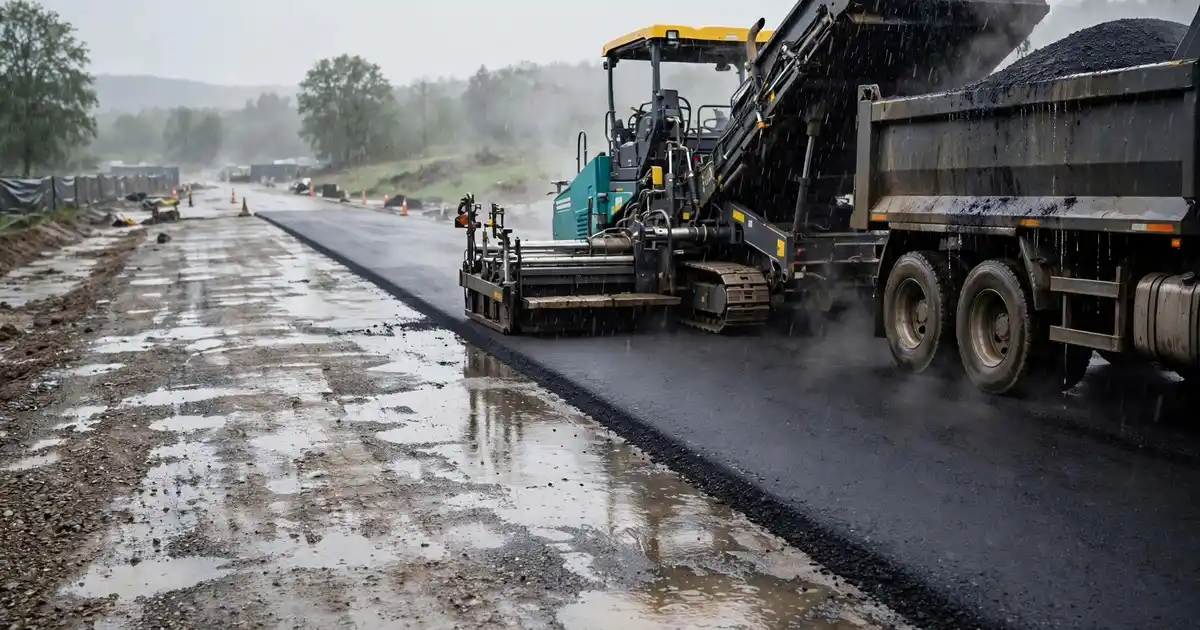
Quick Answer
You should not pave hot mix asphalt in the rain. Rain cools the mix before rollers reach full density, turns water on the base into steam, and stops tack coat from bonding. Some engineering guidance allows light rain to continue mid-job when the surface has no standing water, though most contractors and specifications stop work. Wait until the base is dry — usually 24 hours or more after rain — and keep the new mat dry for at least 24 hours.
Anyone who has booked a paving crew knows the call that comes the night before: the forecast changed. Can you pave asphalt in the rain, or does the job slip to next week? The short answer is no for planned work, with a few narrow exceptions that depend on how hard it rains, what is under the mix, and what the specification allows.
This guide explains why rain causes problems, what engineers and contractors say, what to do when a storm hits mid-job, and how long to wait before and after paving.
When to Pave and When to Stop
| Situation | Pave? | Why |
|---|---|---|
| Steady or heavy rain | No | The mix cools too fast, and the base is wet |
| Standing water or puddles on the base | No | Water under hot mix turns to steam |
| Light rain starts mid-job, no standing water | Sometimes | Some guidance allows it, though most contractors stop |
| Base still wet after rain | No | Tack coat and lift bond suffer |
| Rain stopped, base fully dry | Yes | Normal conditions are back |
| Rain forecast within 24 hours after paving | Reschedule | The fresh mat needs time to cool and set |
Why Rain Is a Problem for Hot Mix Asphalt
Hot mix asphalt is a temperature-sensitive material. Everything from the moment it leaves the plant to the final roller pass depends on keeping the mix above certain thresholds. Rain disrupts that process in three ways — and each one can ruin the finished pavement.
It Cools the Mix Before It Is Compacted
Hot mix asphalt leaves the plant at roughly 275 to 325°F. Crews have a limited window to spread and compact it, and compaction is generally finished once the mat cools to about 175°F, though the exact cutoff depends on the mix. Rain speeds up cooling — and so does a wet surface, through evaporation.
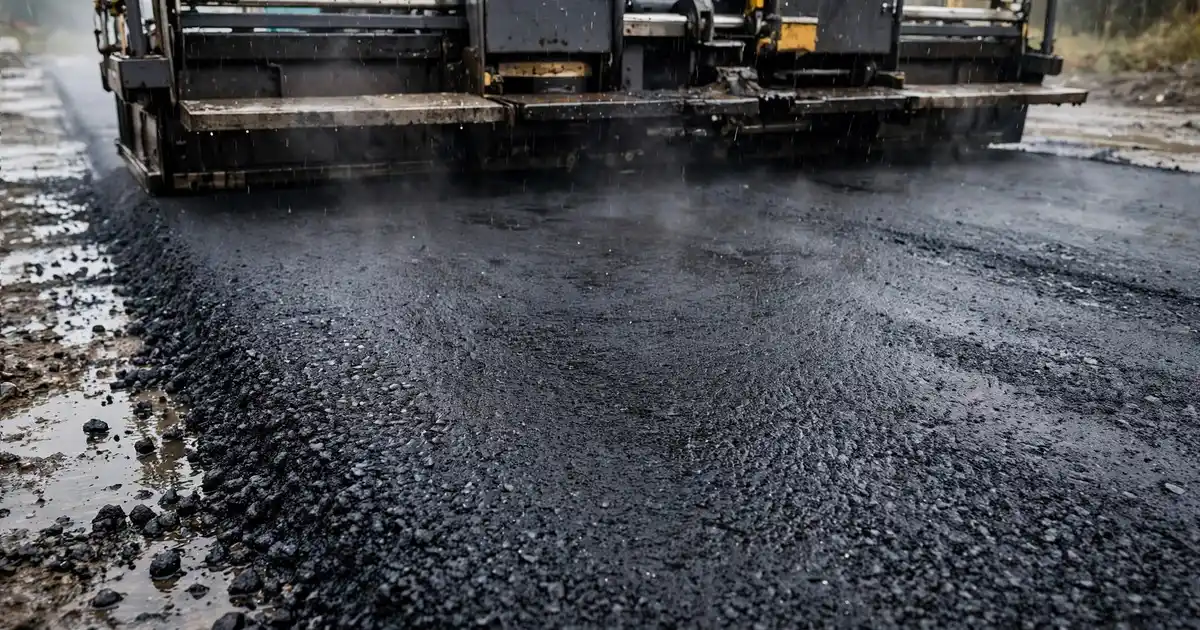
Compaction gives asphalt its strength and its resistance to water. A mat that cools early ends up with too many air voids. Specifications typically target a density of about 92 to 97 percent of the mix's maximum theoretical density, and a mat that cools too soon can fall short of it.
Too many voids let water into the pavement later, which leads to cracking and raveling. Following the proper asphalt compaction temperatures and roller passes ensures the mat locks together before the cessation threshold is reached. Understanding how air voids in asphalt are calculated and controlled shows exactly how much damage a few percentage points of extra void space causes to long-term pavement life.
It Makes Steam Under the Mat
Water on the base or on a lower lift flashes to steam when hot mix covers it. The steam can separate the asphalt binder from the aggregate — a failure called stripping. It also leaves pockets that keep the new layer from bonding to the one below.
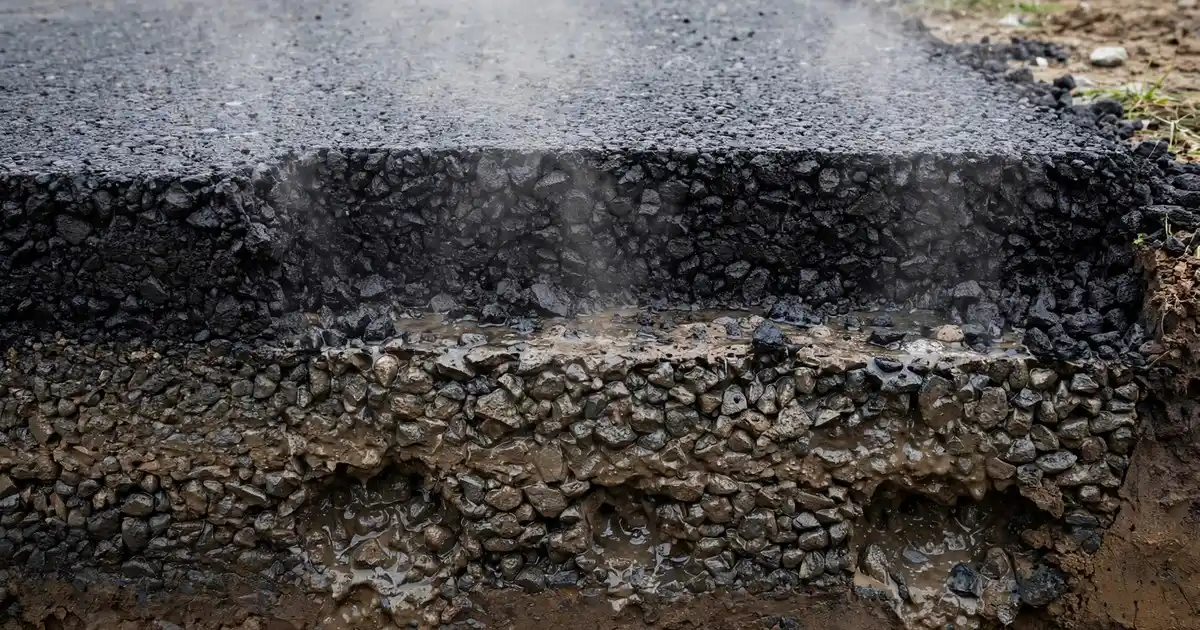
This is why engineering guidance says never to pave over puddles — whether it is raining or not. Even a thin film of standing water on the base is enough to cause localised stripping and bond failure. Wet soil is a risk even after the rain stops, which is why the base needs adequate drying time.
It Breaks the Tack Coat Bond
A tack coat is a thin film of asphalt emulsion that bonds a new layer to the one below. It has to go on a clean, dry surface and break — changing from brown to black — before paving begins. Rain washes it, dilutes it, and keeps it from setting.
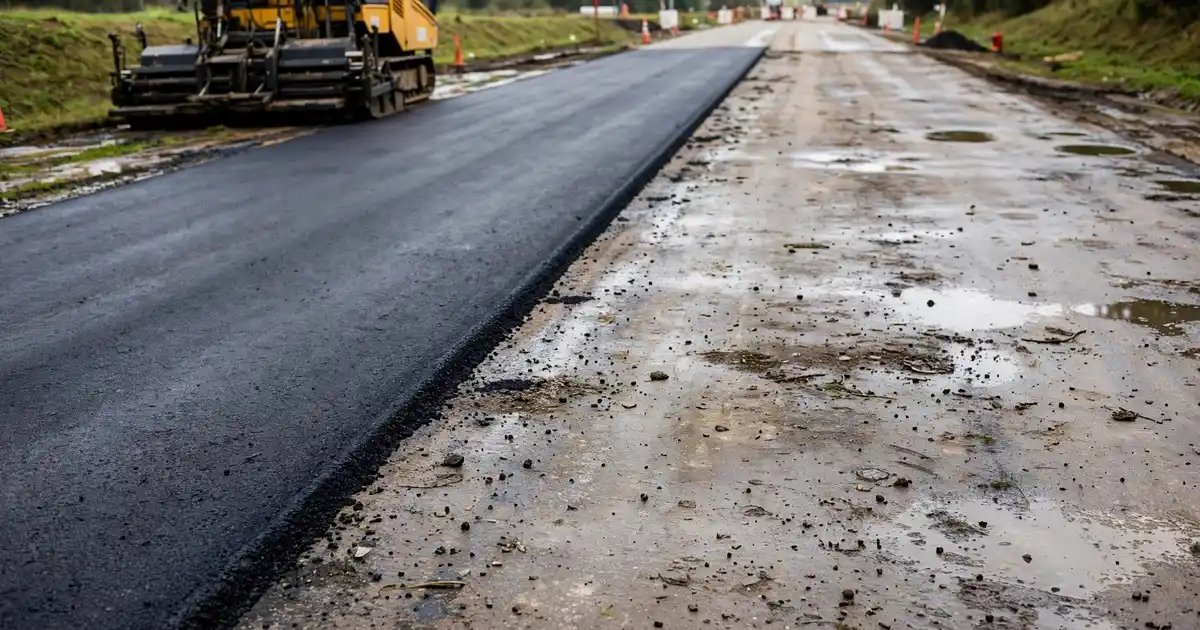
Without a good bond, the layers can slip against each other under traffic and the pavement cracks. The full detail on emulsion break times and application rates is covered in the prime coat vs tack coat comparison. Never apply emulsion tack to pavement at or below freezing, because the water and emulsifier stay in the layer and freeze.
What Engineers Say vs What Contractors Do
The two groups give slightly different answers, and both are worth knowing.
Engineering Guidance
The Asphalt Institute guidance says work that is underway can continue if rain starts, as long as there is no standing water and the rain is not too hard. The main concern is compaction, since the mix cools faster when it lands on a wet surface or when rain falls on an uncompacted mat.
Contractor Practice
Most paving contractors and many agency specifications take a stricter position: they stop when rain starts, because a short compaction window and a thin lift leave little room for error. The general industry practice is not to pave in the rain at all. If your project is under a public specification, the specification decides.
On a private driveway or parking lot, a contractor who stops for rain is protecting the pavement and the warranty. Any contractor who offers to pave over a wet base should explain exactly how they plan to achieve compaction and bond before you agree.
What to Do if Rain Starts Mid-Job
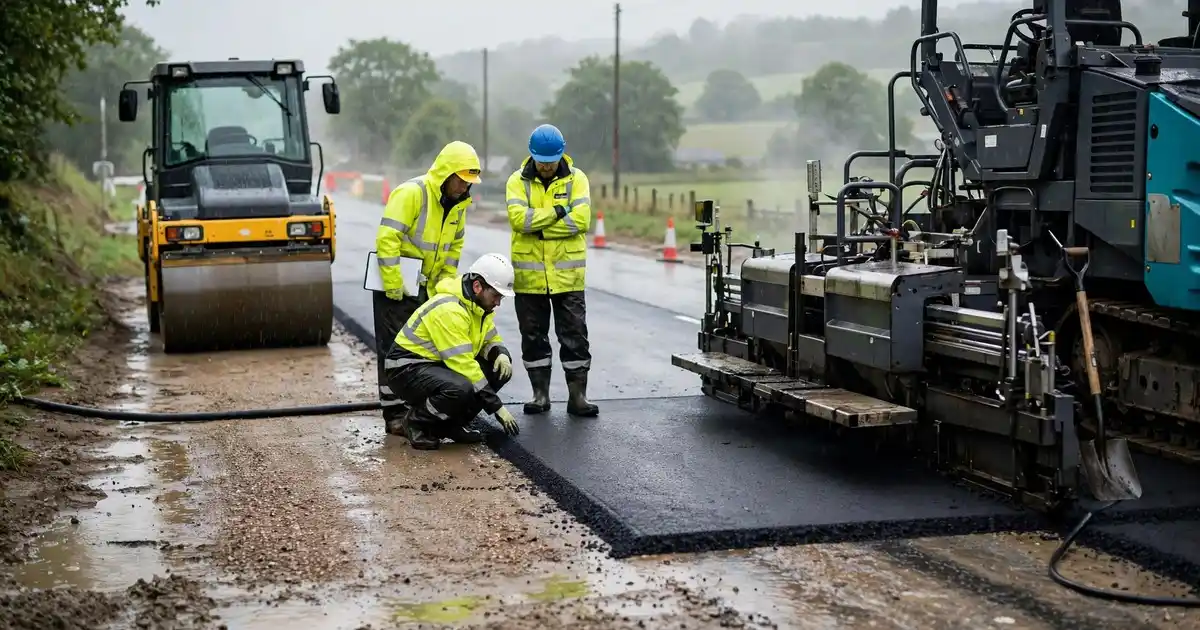
Stop placing new mix
Do not spread material onto a wet surface or over standing water. Any mix placed in those conditions will have poor density and bond.
Roll what is already down
Compact the mat that has been placed while it is still hot enough to compact. Do not abandon it — partial compaction is better than none.
Build a clean transverse joint
Cut a straight, square edge where paving stopped so work can resume cleanly. A rough end will create a weak longitudinal bump when paving restarts.
Protect loaded trucks
Mix that cools in the truck may no longer be workable. Keep loads covered and check temperatures — do not place mix that has dropped below specification.
Re-tack before resuming
Wait for the base to dry fully, then re-apply and allow the tack coat to break before the next lift goes down.
Inspect the finished work
Look at the placed mat for low density areas, tender spots, or sections that look rough or open. These may need testing or remediation.
How Long to Wait After Rain Before Paving
A common guideline is to wait at least 24 hours after rain, and longer if the ground is saturated. After heavy rain, several dry days may be needed before the base is firm enough.
A practical field test is to walk on the base. If you leave footprints, it is too wet to pave. The surface should be dry with no standing water and no soft or muddy spots. Wind and sun speed drying, while shade and cool air slow it.
Field Rule of Thumb
Temperature matters here too. Dark pavement in full sun at 55°F air temperature can have a surface temperature of 70°F or higher. A shaded, wet aggregate base at the same air temperature might be at 45°F — and that cools the mat quickly, cutting compaction time significantly.
| Condition | Minimum Wait | Notes |
|---|---|---|
| Light shower, good drainage | 24 hours | Walk test — no footprints |
| Moderate rain | 24–48 hours | Check base firmness |
| Heavy rain / saturation | 48–72 hours or more | May need multiple dry days |
| Clay subgrade after rain | 72 hours or more | Clay retains moisture longest |
| Sandy / well-drained base | 24 hours | Dries fastest with sun and wind |
Rain and Temperature Together
Most hot mix specifications call for a minimum air temperature of about 50°F and rising. Some agencies allow paving down to 40°F with warm mix asphalt or polymer-modified mixes — always check the specification and the supplier. Review our asphalt paving temperature chart and lift thickness table for ambient thresholds by layer depth.
Cool, wet weather is the worst combination because the mat loses heat from both the air and the surface moisture. Thicker lifts hold heat longer, which is one reason lift thickness matters in cool weather. The asphalt layer thickness guide covers how minimum lift depth is specified for different temperature conditions.
| Condition | Risk Level | Action |
|---|---|---|
| Air temp above 60°F, dry | Low | Normal paving window |
| Air temp 50–60°F, light rain | Medium | Monitor closely, consider stopping |
| Air temp below 50°F, any rain | High | Stop — compaction window too short |
| Air temp 40–50°F, dry | Medium | Use warm mix or polymer-modified |
| Air temp below 40°F | Very High | Do not pave hot mix |
Rain After Paving — Timing Decides the Risk
High Risk — Rain on Uncompacted Hot Mat
- ✗Cools the mix before rollers finish
- ✗Compaction falls short of spec density
- ✗Excess air voids reduce pavement life
- ✗Early cracking and raveling likely
Lower Risk — Rain on Compacted, Cooled Mat
- ✓Light rain generally does not damage it
- ✓Mat has already reached target density
- ✓Drainage design handles surface water
- ✓Standing water still a concern in first few days
Most guidance asks for at least 24 hours of dry weather after paving. Some sources suggest avoiding heavy rain for as long as 72 hours. Fresh asphalt is soft enough that you should keep vehicles off it for 24 to 48 hours as well.
If rain is forecast right after paving, ask the contractor about timing. Sealcoat is a separate matter — it needs about 24 to 48 hours of dry weather after application. The asphalt driveway sealcoating guide covers exactly when to seal a new surface and how long to wait after rain.
Can You Use Cold Mix Asphalt in the Rain?
Cold mix asphalt is formulated for damp and cool conditions, and crews use it for temporary pothole repairs in wet weather. Standing water still prevents a good bond, and cold mix is a temporary repair — not a substitute for hot mix paving.
The cold mix bitumen guide covers exactly when it works, what formulations hold up in wet weather, and where it falls short of hot mix performance for permanent repairs.
Planning Around the Forecast
Weather decides most paving schedules. Build a buffer in from the start and the job runs smoothly. Ignore the forecast and a failed pavement costs far more to fix than a one-week delay.
Check the forecast several days out
Aim for a dry base, a dry day for paving, and about 24 hours without rain afterward. Five-day forecasts are reliable enough to plan around.
Pick the right season
Late spring to early fall gives the warmest and driest windows. Spring brings the most rain risk. Early autumn often has stable, dry weather ideal for paving.
Watch temperature as well as rain
Air near 50°F and rising, with a dry, sun-warmed base, gives crews the longest compaction window. Cold mornings that warm up are better than warm mornings that cool.
Agree on a rain date
Contractors reschedule for weather routinely. A backup date written into the contract avoids arguments and delays on the day of the job.
Accurate material estimation also helps keep a project on schedule. If you need to calculate tonnage for a rescheduled pour, the Bitumen Calculator at BitumenCalcPro gives you fast, accurate asphalt quantity estimates by area, thickness, and mix type.
Signs Rain Damaged a Fresh Pavement
Poor compaction does not always show up right away. Low density can take time to appear as cracking and raveling, which is why density testing matters on larger projects.
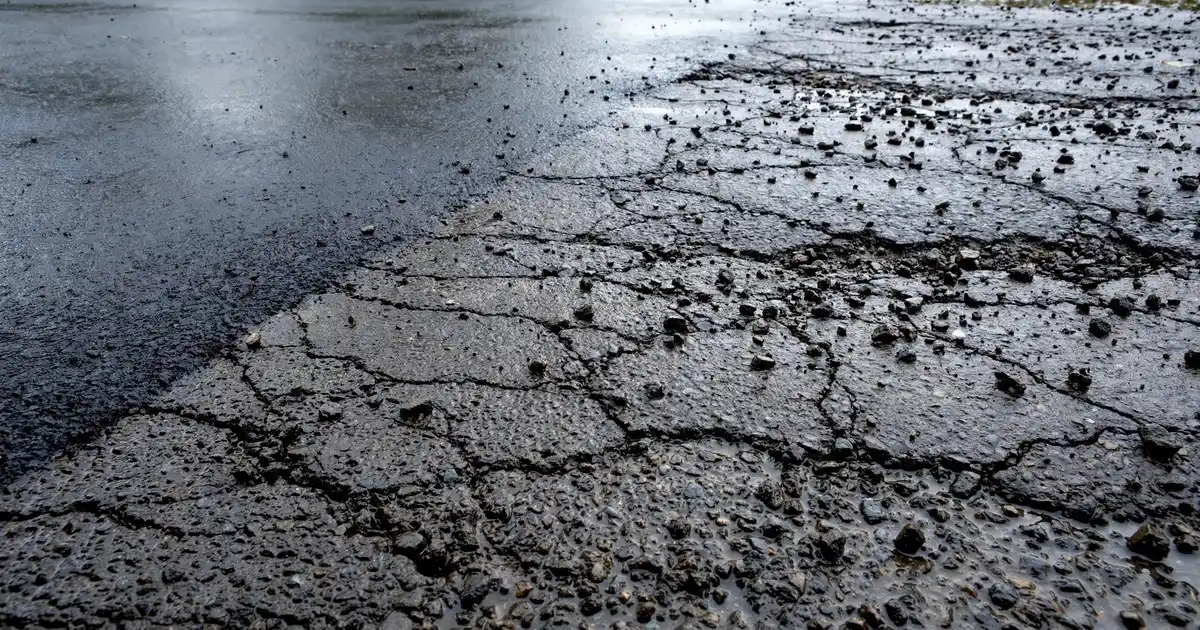
Identifying these warning signs early is part of understanding broader asphalt cracking types and their root causes. Rain-related compaction failures often start as raveling or surface cracking and progress quickly to structural damage if left untreated.
Questions to Ask Your Contractor
Before any paving project — especially one scheduled in marginal weather — these questions separate experienced contractors from those cutting corners.
What is your cutoff for rain on the day, and who makes the call?
How will you handle a storm that starts mid-job?
Will the base be fully dry before paving starts?
How long do I need to keep traffic off, and what if it rains?
Is the tack coat applied and allowed to break before the mix goes down?
What density testing will you do, and what happens if it fails spec?
Sum Upy
You cannot pave hot mix in the rain without risking the pavement. Rain cools the mix before it is compacted, makes steam when it meets a wet base, and keeps tack coat from bonding. If a storm starts mid-job, stop, roll what is down, and build a clean transverse joint.
Wait at least 24 hours after rain for the base to dry, and protect the new mat for 24 hours or more after paving. Planning around the forecast costs a few days at most and protects a pavement that should last years. For fixing asphalt driveway damage caused by poor compaction or premature rain exposure, early intervention prevents minor raveling from becoming a full-depth failure.
The FHWA Asphalt Pavement resources provide free agency-level guidance on compaction temperature windows, weather limitations, and quality assurance testing for hot mix paving operations.
Frequently Asked Questions
Can you pave asphalt in the rain?
Planned paving should not happen in the rain. Rain cools the mix before compaction is complete, creates steam on a wet base, and keeps tack coat from bonding properly. Some engineering guidance allows light rain to continue mid-job when there is no standing water, though most contractors and specifications stop work.
Can you lay asphalt in light rain?
Rarely. Light rain still cools the mat and wets the tack coat. A job already underway may continue under some engineering guidance if the surface has no standing water, but most contractors stop to protect pavement quality and their warranty.
How long after rain can you pave asphalt?
Wait at least 24 hours after rain, and longer if the ground is saturated. After heavy rain, several dry days may be needed. The base should be dry and firm — if you leave footprints walking on it, it is too wet to pave.
What happens if it rains on fresh asphalt?
Rain on a hot, uncompacted mat harms compaction by cooling the mix too fast, leaving excess air voids. Light rain on a compacted, cooled mat is generally not a problem. Standing water on fresh asphalt in the first few days can weaken the surface and lead to early cracking or potholes if drainage is poor.
How long should fresh asphalt stay dry?
At least 24 hours, and longer for heavy rain. Some sources suggest keeping the mat dry for up to 72 hours. Fresh asphalt is soft enough that you should also keep vehicle traffic off it for 24 to 48 hours.
Can you pave over a wet base?
No. Water under hot mix turns to steam when covered, which can strip the binder from the aggregate and leave pockets that prevent the new layer from bonding to the one below.
What is the minimum temperature for paving asphalt?
Most hot mix specifications call for a minimum air temperature of about 50°F (10°C) and rising. Some agencies allow paving down to 40°F (4°C) with warm mix asphalt or polymer-modified mixes — always check your project specification.
Can you use cold mix asphalt in the rain?
Cold mix is designed for damp and cool conditions and works for temporary pothole repairs in wet weather. Standing water still prevents a good bond, and cold mix is a temporary repair, not a substitute for hot mix paving.

Founder & Web Developer
Nabeel Awan is a web developer and the founder of BitumenCalcPro. His work focuses on web development and building practical online tools, with a strong interest in civil engineering, asphalt, bitumen, pavement construction, and construction technology.