Quick Answer
To calculate air voids in asphalt, measure the bulk specific gravity (Gmb) of a compacted sample and the maximum specific gravity (Gmm) of the loose mix. Then use: Air voids (%) = 100 × (1 − Gmb ÷ Gmm). A Gmb of 2.419 and a Gmm of 2.520 give 4.0% air voids. Most dense-graded mixes target about 4% in the lab and roughly 3% to 8% in the field.
Air voids decide how long a pavement lasts. Too many, and water and air get into the mat. Too few, and the mix ruts and bleeds in the first hot summer.
This guide shows how to calculate air voids in asphalt from two lab measurements. You'll get the formula, the test methods behind each input, two worked examples, target ranges, and the mistakes that throw results off. If you work with Superpave, Marshall, or field cores, the steps are the same.
What Are Air Voids in Asphalt?
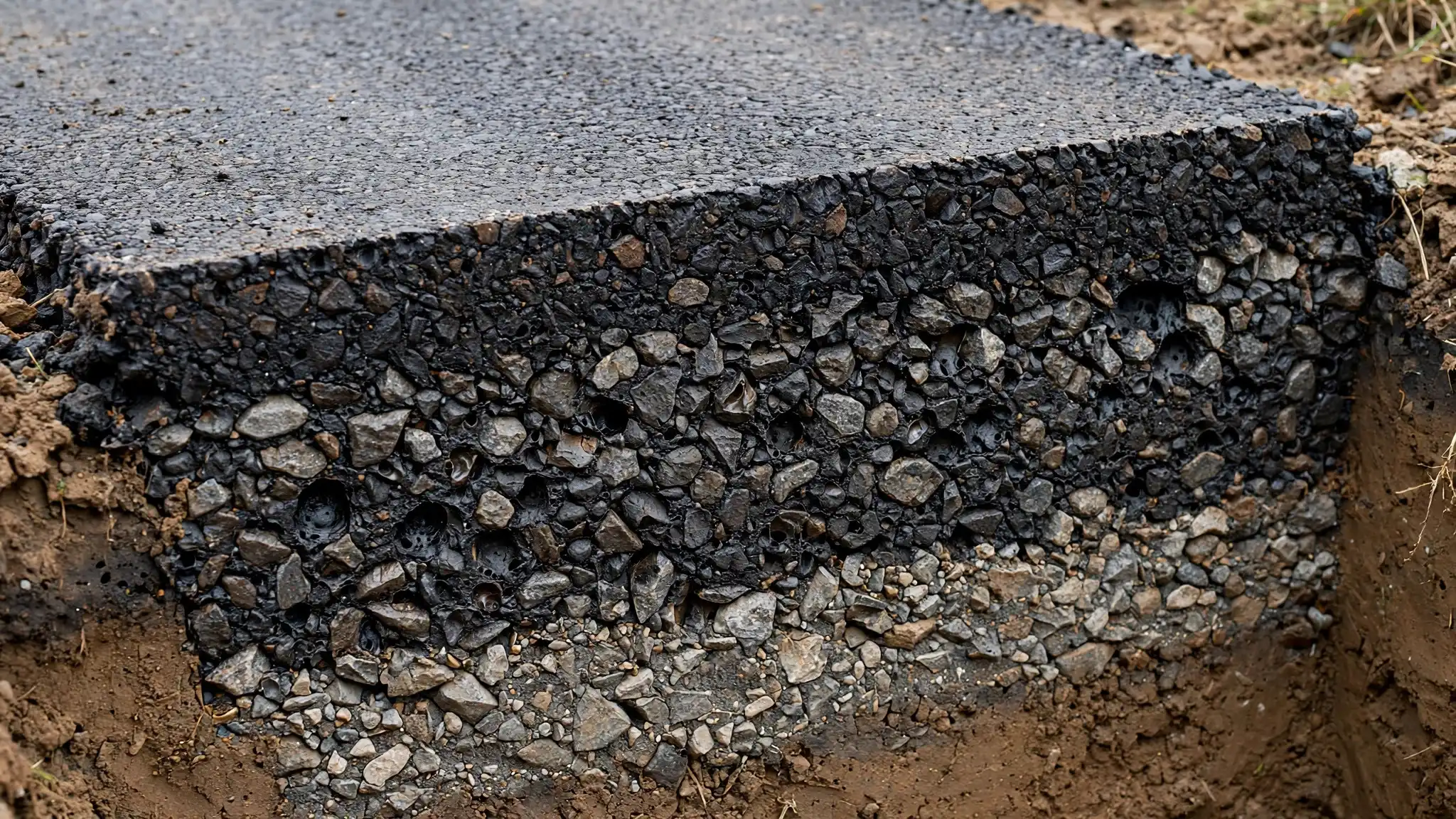
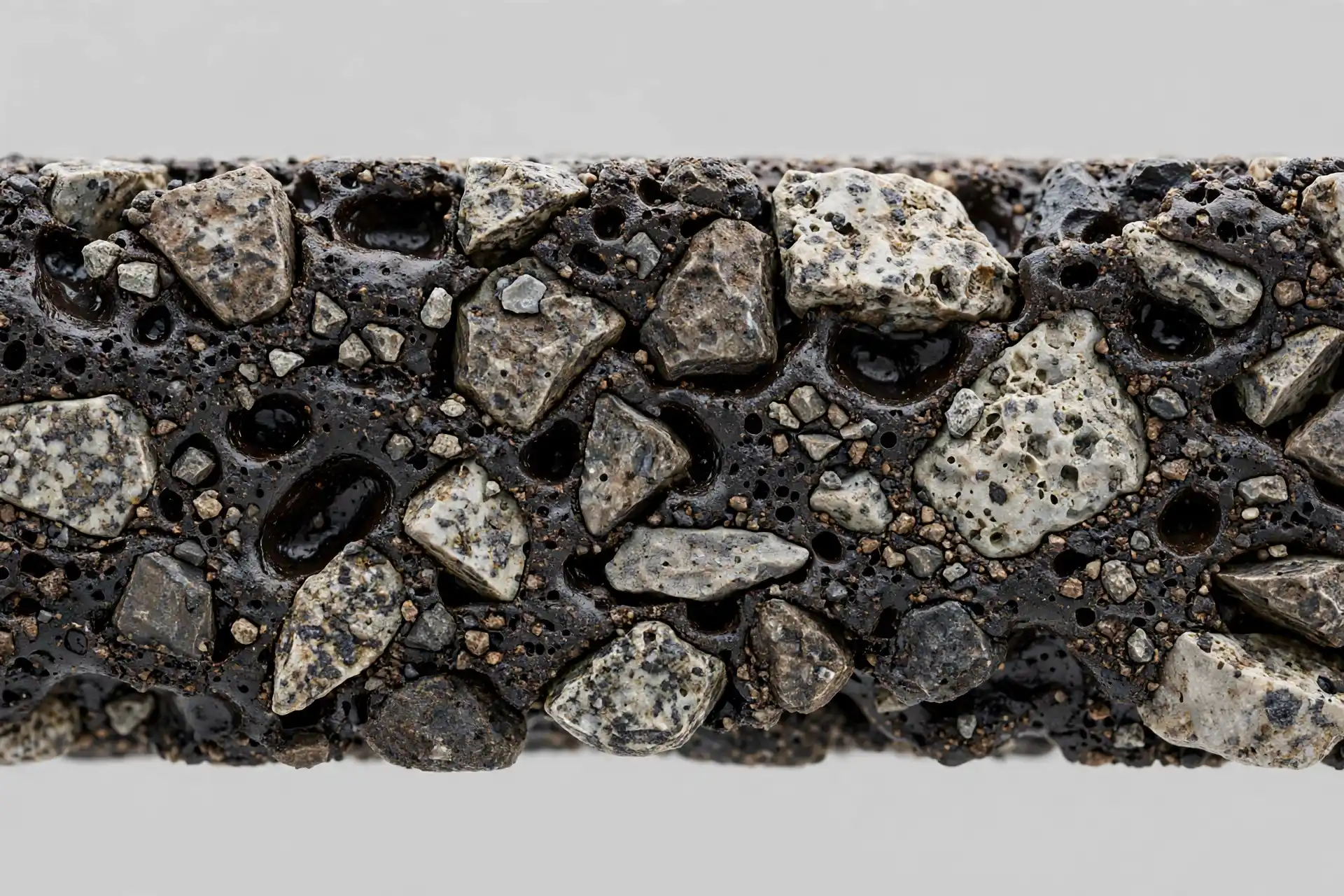
Air voids, written as Va or Pa, are the pockets of air trapped between coated aggregate particles in a compacted asphalt mix. They are expressed as a percentage of the total specimen volume.
A compacted specimen of asphalt mix is made up of three things: aggregate, binder, and air. The aggregate takes up most of the volume. Binder fills a portion of the gaps between particles. Air fills the rest. That remaining air is what Va measures.
Va is not the same as VMA. VMA is the total void space between aggregate particles — it includes both the binder-filled voids and the air-filled voids. Va is only the unfilled part. Keep this straight from the beginning or the numbers will not make sense.
Va shows up in every mix design method. Superpave selects the design binder content at a target Va of 4.0%. Marshall design does the same thing. Field cores check whether compaction brought Va down from the lab value into the allowable field range.
The Air Voids Formula
The formula for air voids in asphalt has two inputs: bulk specific gravity (Gmb) and maximum theoretical specific gravity (Gmm).
Va (%) = 100 × (1 − Gmb ÷ Gmm)
Va = percent air voids | Gmb = bulk specific gravity of compacted specimen | Gmm = maximum theoretical specific gravity of loose mix
The fraction Gmb ÷ Gmm tells you what proportion of the theoretical maximum density the compacted specimen has reached. If Gmm is 2.520 and Gmb is 2.419, the ratio is 0.9599. The specimen is at 95.99% of maximum density. The remaining 4.01% is air — that is Va.
| Term | Full Name | Standard | What It Measures |
|---|---|---|---|
| Gmb | Bulk Specific Gravity | AASHTO T 166 / ASTM D2726 | Density of compacted specimen including surface voids |
| Gmm | Maximum Theoretical Sp. Gr. | AASHTO T 209 / ASTM D2041 | Density of loose mix with zero air |
| Va | Air Voids | Calculated | Percent of total volume that is air |
| VMA | Voids in Mineral Aggregate | Calculated from Gmb + Gsb | Total void space between aggregate particles |
| VFA | Voids Filled with Asphalt | Calculated from VMA + Va | Percent of VMA occupied by binder |
What You Need: Gmb and Gmm
Measuring Gmb — Bulk Specific Gravity
Gmb is measured on a compacted specimen — a lab gyratory puck, a Marshall specimen, or a field core. The standard method is AASHTO T 166 (ASTM D2726), the saturated surface-dry (SSD) procedure.
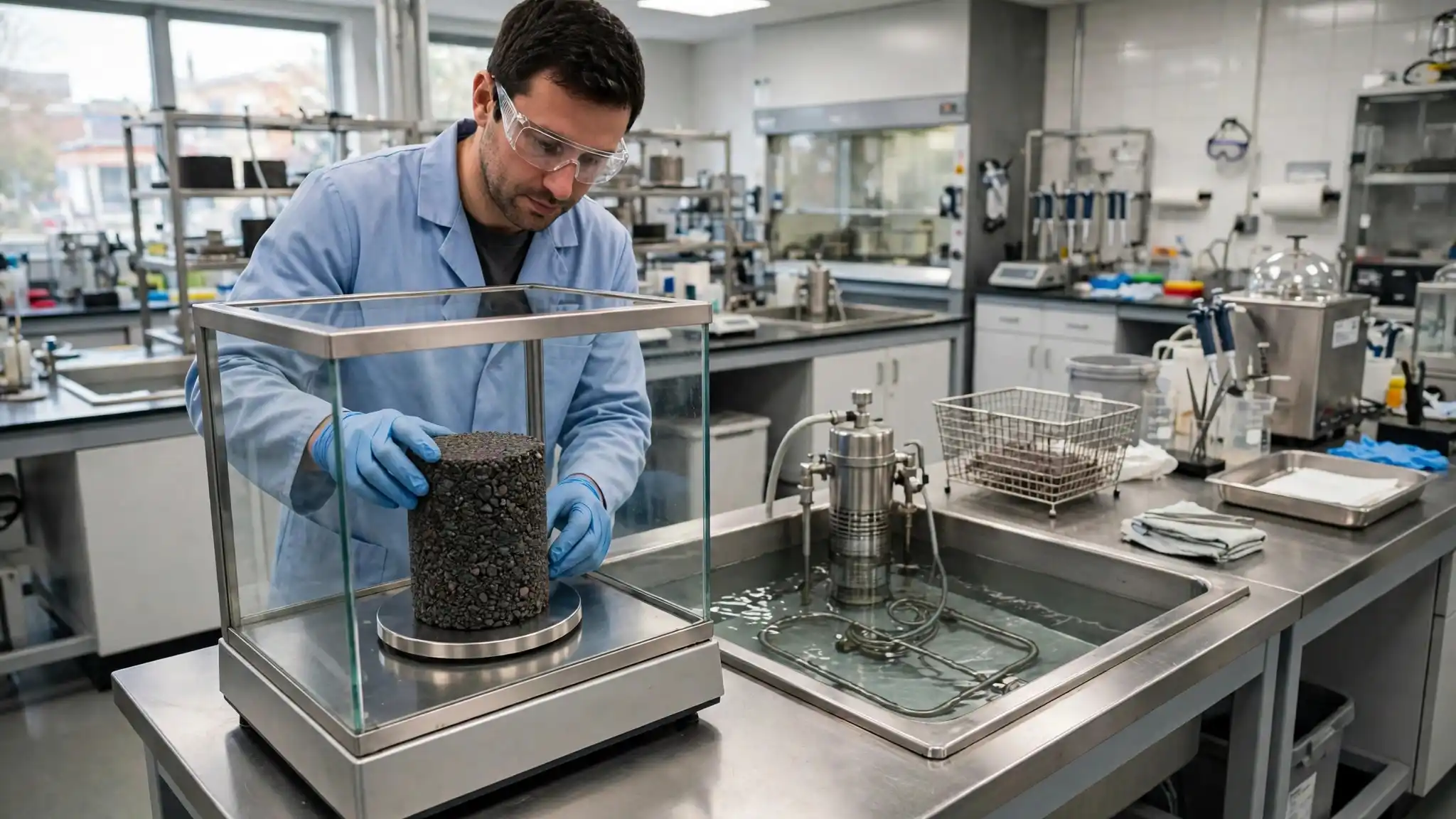
Three weights go in:
- A — dry mass of specimen in air (g)
- B — saturated surface-dry mass of specimen in air (g)
- C — submerged mass of specimen in water (g)
For cores with a large surface texture or open-graded mixes, use the dimensional method (AASHTO T 269 / ASTM D3203) or the CoreLok vacuum method instead. Surface texture on open mixes absorbs more water during SSD saturation and inflates B, pulling Gmb down. This is an important distinction when working with asphalt yield and compacted density calculations that depend on Gmb for accuracy.
Measuring Gmm — Maximum Theoretical Specific Gravity
Gmm is measured on a loose, uncompacted sample of the same mix. The test is called the Rice test after its developer. Standard: AASHTO T 209 (ASTM D2041).
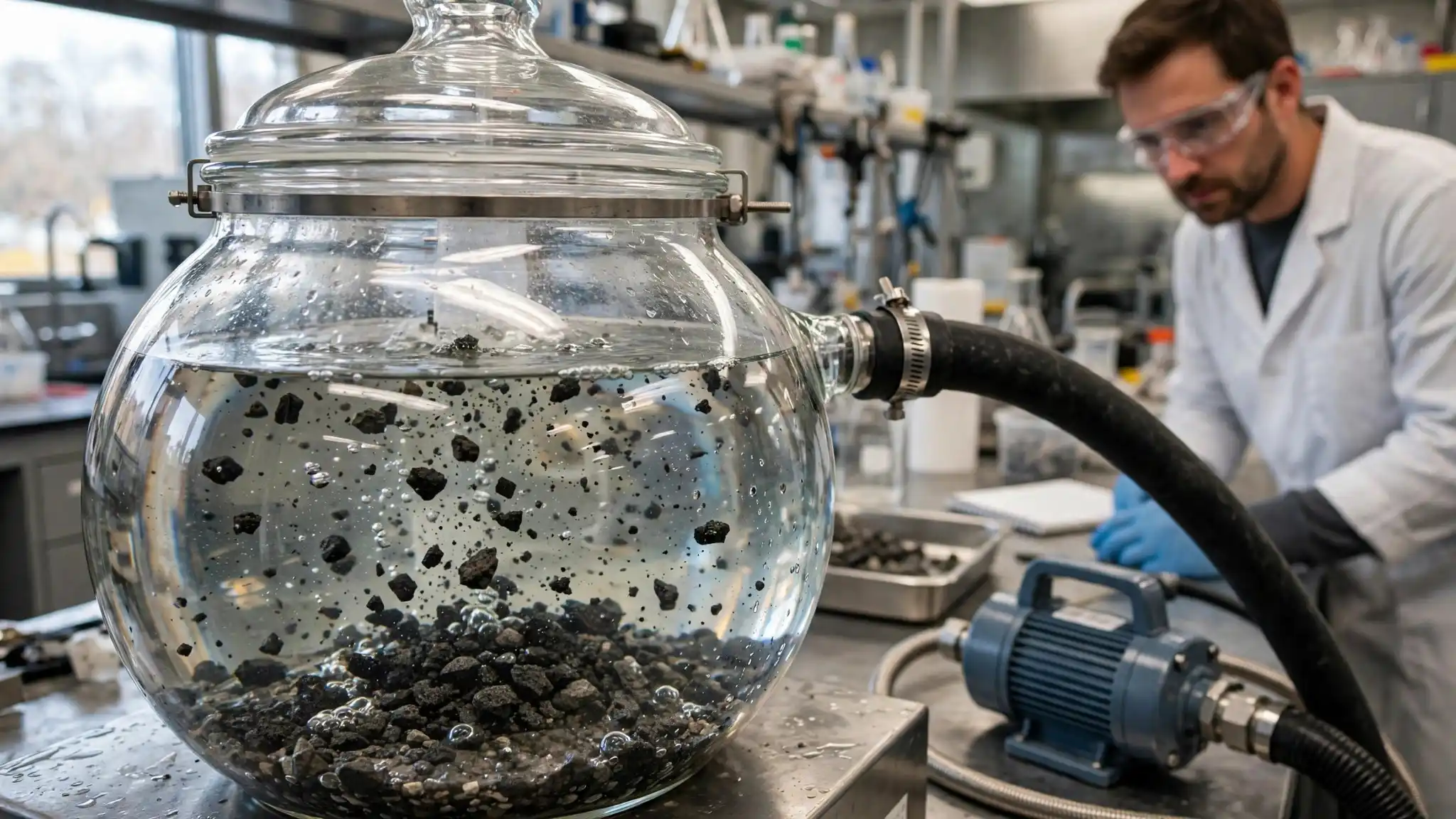
Steps of the Rice test:
- Separate the loose mix by hand to break clumps.
- Place the mix in the vacuum container with enough water to submerge it.
- Apply vacuum (≥ 27.5 inHg) for 15 minutes while agitating.
- Release vacuum, fill to the calibration mark, and weigh.
Where A = dry mass of mix, D = mass of container + water, E = mass of container + water + mix submerged.
Gmm can also be calculated from mix composition if you know the specific gravity and content of each material. For standard dense-graded mixes, the Rice test is preferred because it accounts for the actual binder and aggregate in the specific batch. The resulting Gmm value directly relates to bitumen binder density values used across mix design calculations.
Lab Specimen Example
Here are the numbers from a Superpave mix design at the design number of gyrations (Ndesign = 75).
| Measurement | Value | Method |
|---|---|---|
| Dry mass in air (A) | 1,197.4 g | Scale |
| SSD mass in air (B) | 1,200.6 g | Scale |
| Submerged mass (C) | 686.1 g | Suspension scale |
| Gmb | 1197.4 ÷ (1200.6 − 686.1) = 2.329 | AASHTO T 166 |
| Gmm (Rice test) | 2.491 | AASHTO T 209 |
| Va | 100 × (1 − 2.329 ÷ 2.491) = 6.5% | Calculated |
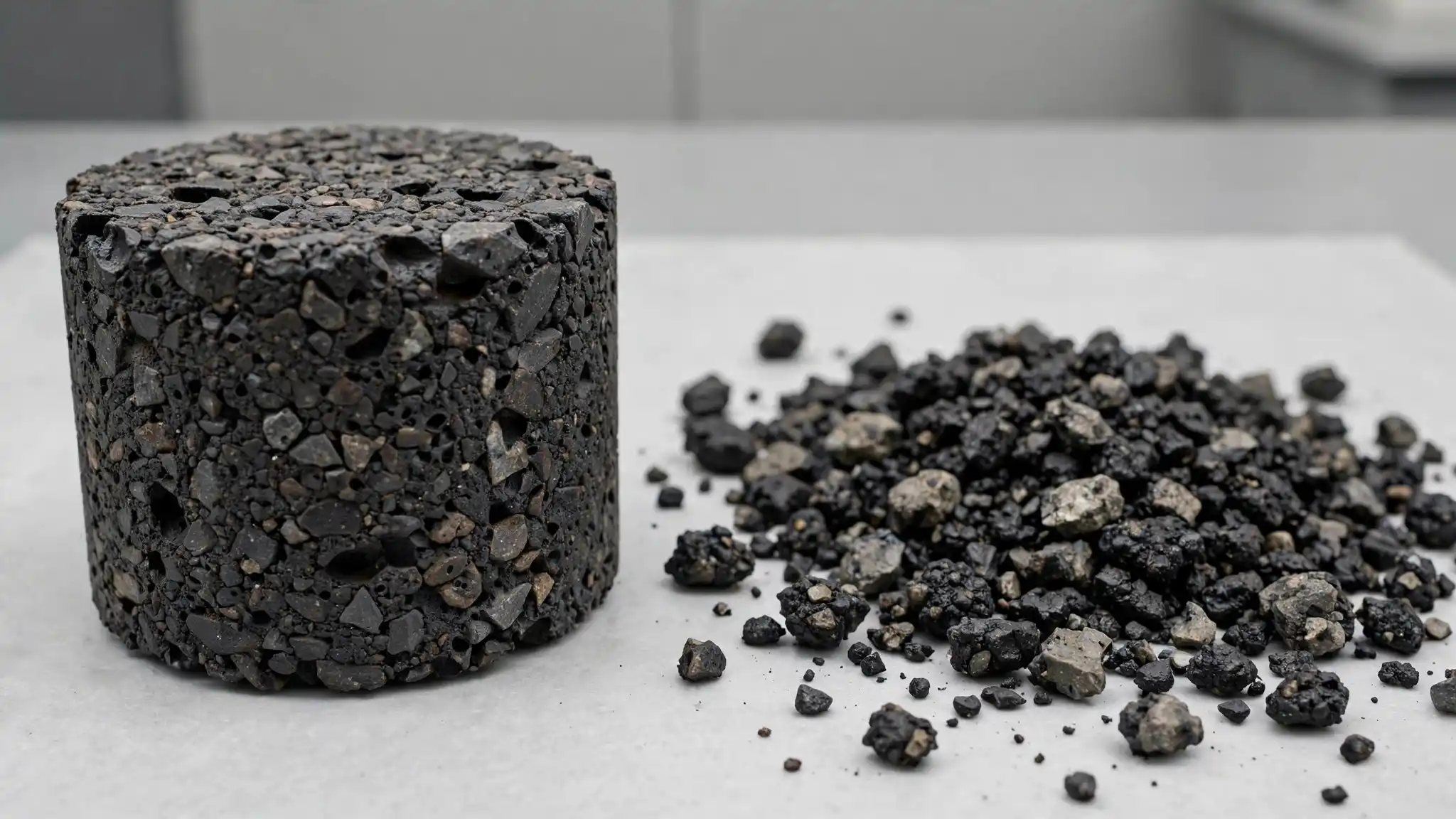
At 6.5% Va, this mix is above the 4% design target. That means the design binder content needs to change, or the mix was not compacted correctly in the lab. The designer would typically increase binder content in increments of 0.5% and retest until Va lands at 4% at Ndesign.
At the final design binder content, all volumetric properties — Va, VMA, VFA, Gmb, Gmm — are recalculated and checked against the Superpave criteria table. The design only passes if all properties are within spec simultaneously. This holistic check connects directly to decisions about pavement layer thickness and mix design for the design traffic level.
Field Core Example
Field cores check compaction quality. The lab gives you the Gmm from the same day's production. The core gives you the field Gmb. The difference tells you how well the paving crew compacted the mat using proper asphalt roller passes and temperature windows.
| Measurement | Value | Source |
|---|---|---|
| Dry mass in air (A) | 912.3 g | Scale |
| SSD mass in air (B) | 914.0 g | Scale |
| Submerged mass (C) | 524.1 g | Suspension scale |
| Gmb (field) | 912.3 ÷ (914.0 − 524.1) = 2.340 | AASHTO T 166 |
| Gmm (plant, same day) | 2.491 | AASHTO T 209 |
| Va (field) | 100 × (1 − 2.340 ÷ 2.491) = 6.1% | Calculated |
| % Compaction | 2.340 ÷ 2.491 × 100 = 93.9% | Calculated |
Most highway specs require field Va between 3% and 8%, and percent compaction at 92% or greater. This core meets both: 6.1% Va (within range) and 93.9% compaction (above 92%).
If Va was above 8%, the inspector would call for more roller passes or investigate roller patterns. If Va was below 3%, the crew may have used too many passes or the mix temperature dropped before compaction. See the section on common mistakes below for more on what causes each condition.
Cores should be taken randomly across the mat — not at the edge, not directly in the wheel path of the roller, and not at cold joints. At least one core per 1,000 linear feet per lane is a typical minimum.
VMA and VFA
Va tells you how much air is in the mix. VMA tells you how much total void space exists between aggregate particles. VFA tells you what fraction of that VMA is filled with binder.
The formulas are:
Ps = percent aggregate by total mass of mix (decimal) | Gsb = bulk specific gravity of aggregate blend
For a mix with Gmb = 2.419, Ps = 0.945, Gsb = 2.720:
VMA = 100 − (2.419 × 0.945 ÷ 2.720) = 100 − 84.0 = 16.0%
VFA = 100 × (16.0 − 4.0) ÷ 16.0 = 75.0%
VMA must be large enough to hold both the design binder film and the target air voids. If VMA is too low, increasing binder content will drive Va down instead of building film thickness — the mix runs out of void space. If VMA is too high, the mix may need an unusually large binder content to reach 4% Va, raising costs and bleeding risk.
Superpave minimum VMA values run from 13% for large-stone mixes (37.5 mm NMAS) to 15% for 19 mm and 19% for 4.75 mm fine-graded mixes. The binder grade selection for the right VFA range also affects how the mix performs at the boundary of these targets — a stiffer grade leaves less room for VFA error before the mix becomes brittle.
Target Ranges by Mix Type
Va targets differ between lab design and field compaction, and between mix types. These are general Superpave and standard highway department values — always check the project specification.
| Context | Va Target / Range | Notes |
|---|---|---|
| Superpave lab design (Ndesign) | 4.0% | Design binder content set at this Va |
| Superpave lab (Ninitial) | < 11% | Prevents tender mix at start of compaction |
| Superpave lab (Nmax) | > 2% | Prevents over-compaction under traffic |
| Field compaction — highway | 3% to 5% | Most DOT specs; < 3% risks rutting |
| Field compaction — general | 3% to 8% | Wider range allowed on lower-volume roads |
| Surface course (fine-graded) | 3% to 5% | Tight range for water resistance |
| Base course (coarse-graded) | 4% to 8% | More tolerance; drainage layer below |
| Open-graded friction course | 15% to 22% | Intentionally high for drainage/noise |
The Ninitial criterion (Va < 11%) checks whether the mix is too stiff to compact at all. The Nmax criterion (Va > 2%) checks whether traffic will drive Va to zero over time, causing rutting and bleeding. Both checks run at the same design binder content — only the number of gyrations changes.
Why Air Voids Matter
Va is the single number that connects mix design to field performance. It sits at the intersection of durability, rutting resistance, and water damage resistance.
Too Few Air Voids (Va < 3%)
- ✗Rutting under wheel loads
- ✗Binder bleeding to surface
- ✗Low skid resistance (slick surface)
- ✗Shoving at intersections and bus stops
- ✗Pavement instability in hot weather
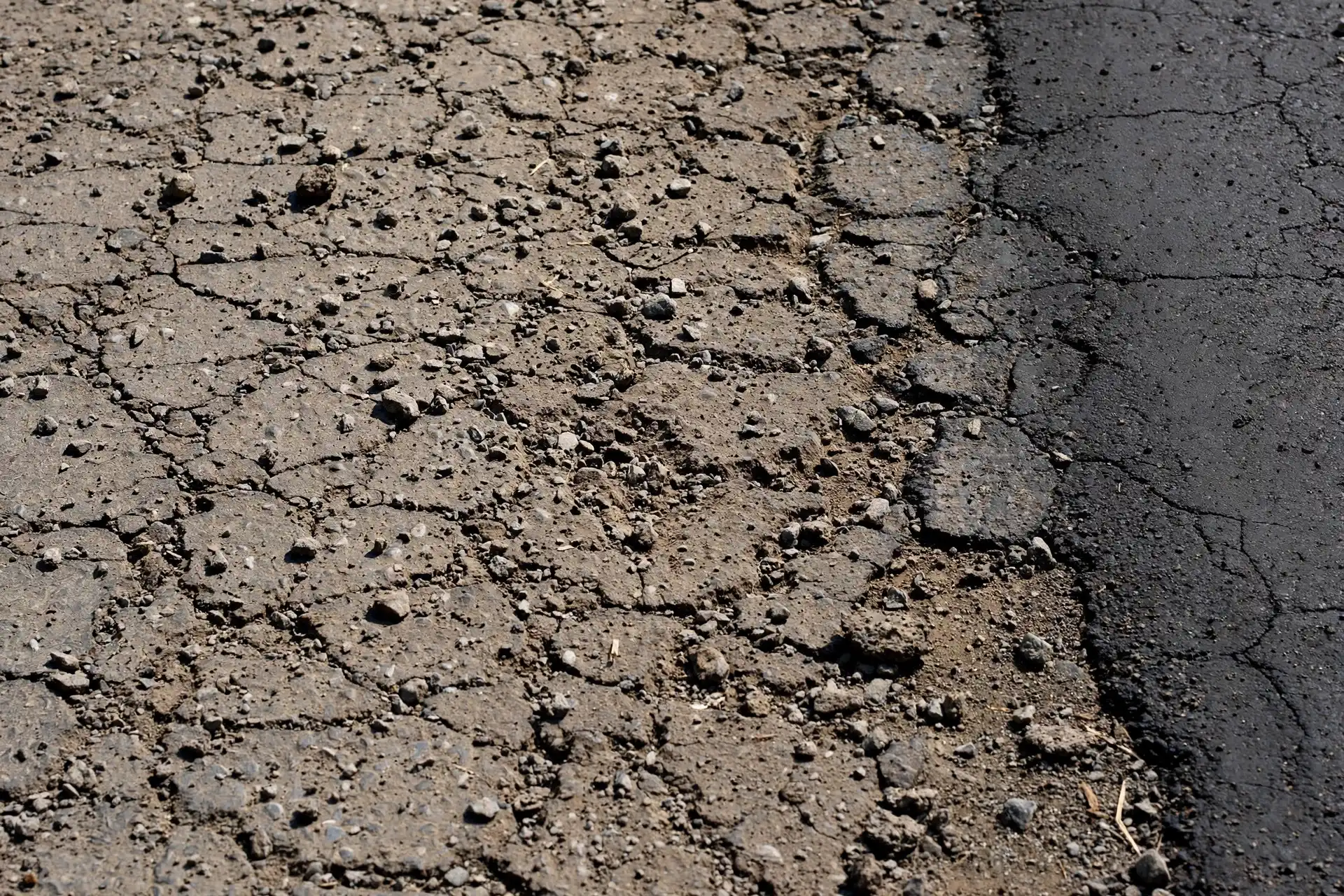
Too Many Air Voids (Va > 8%)
- ✗Water infiltration and freeze-thaw damage
- ✗Accelerated binder oxidation
- ✗Raveling — aggregate loss from surface
- ✗Fatigue cracking under repeated loading
- ✗Shortened pavement life
High air voids are a leading driver of the asphalt cracking types linked to low density — fatigue cracking, longitudinal wheel-path cracks, and block cracking all accelerate when Va is chronically above 7% or 8%.
Research shows that each 1% increase in air voids above the optimum reduces pavement life by roughly 10%. A mat compacted to 8% Va instead of 4% will last about 60% as long as intended. This sensitivity is why compaction quality is closely monitored on highway projects.
Common Mistakes When Calculating Air Voids
Using Gmb from the wrong test method for the mix type
Open-graded mixes absorb water during SSD saturation. The standard SSD method (AASHTO T 166) gives a falsely low Gmb for these mixes. Use the CoreLok vacuum procedure or dimensional method (AASHTO T 269) instead. Getting this wrong pushes Va high — the core looks under-compacted when it is not.
Mixing up plant Gmm and design Gmm
The design Gmm is from the mix proportions. Plant Gmm is measured on actual production samples. These should be close but are rarely identical. Field Va calculations must use the production Gmm from the same day — using the design Gmm can hide real changes in the mix.
Not conditioning the sample before Gmm testing
AASHTO T 209 requires the sample to be at room temperature (25°C) before testing. Hot mix straight from the plant gives a lower Gmm because binder is expanded. The error is small but systematic.
Sampling bias in field cores
Taking cores only at easy-access locations or at the paver mat center will produce a biased data set. Corner areas, longitudinal joints, and transition zones are where compaction typically falls off — these spots need their own core locations.
Confusing Va with percent compaction
Percent compaction = (Gmb ÷ Gmm) × 100. Va = 100 × (1 − Gmb ÷ Gmm). They are complementary. 95% compaction is 5% Va. Both come from the same ratio, but specs often state one or the other — do not calculate Va and compare to a compaction target, or vice versa.
Avoiding these mistakes early is part of the broader challenge of common asphalt mix design and estimation errors that drive up project cost and reduce pavement performance.
How to Fix Out-of-Range Air Voids
In Mix Design (Lab)
If Va is too high at Ndesign, increase binder content. More binder fills more of the void space. Increase in steps of 0.5% by weight of mix. At each step, compact a new set of specimens and recalculate all volumetric properties.
If Va is too low at Ndesign, reduce binder content. If reducing binder content pushes VMA too low or VFA out of range, the aggregate gradation may need to change — typically moving coarser to open up VMA.
In the Field (Compaction)
High field Va (poor compaction) — Add roller passes. Verify mat temperature at the breakdown roller: most dense-graded mixes need compaction above 230°F (110°C). Check roller weight and speed.
Low field Va (over-compaction) — Reduce roller passes. Check that the mix temperature has not been elevated — high-temperature mix over-compacts easily and can also binder-drain on the screed.
Field Rule of Thumb
One additional roller pass typically reduces air voids by about 0.5% to 1.0% on a standard dense-graded mix. This varies with roller weight, tire pressure, mix temperature, and lift thickness. Use it only as a starting estimate — always verify with cores.
Quick Reference Table
All the key formulas and standards in one place.
| Property | Formula | Standard | Target |
|---|---|---|---|
| Air Voids (Va) | 100 × (1 − Gmb ÷ Gmm) | Calculated | 4% (lab); 3–8% (field) |
| % Compaction | (Gmb ÷ Gmm) × 100 | Calculated | ≥ 92–96% (varies by spec) |
| Gmb | A ÷ (B − C) | AASHTO T 166 / ASTM D2726 | Mix-specific |
| Gmm | A ÷ (A + D − E) | AASHTO T 209 / ASTM D2041 | Mix-specific |
| VMA | 100 − (Gmb × Ps ÷ Gsb) | Calculated | ≥ 13–19% (depends on NMAS) |
| VFA | 100 × (VMA − Va) ÷ VMA | Calculated | 65–75% (most traffic levels) |
For a full primer on AASHTO and ASTM test methods for asphalt volumetrics, the Asphalt Institute Mix Design resources provide the complete MS-2 manual used by most state agencies. The FHWA Asphalt Mix Design page also publishes free guidance documents on Superpave volumetric design for public use.
Frequently Asked Questions
What is the formula for air voids in asphalt?
Air voids (Va%) = 100 × (1 − Gmb ÷ Gmm). Gmb is the bulk specific gravity of the compacted specimen, measured by AASHTO T 166 or ASTM D2726. Gmm is the maximum theoretical specific gravity of the loose mix, measured by AASHTO T 209 or ASTM D2041.
What is an acceptable air void percentage in asphalt?
Lab-compacted specimens target 4.0% air voids at Ndesign gyrations in Superpave design. Field compacted pavement should reach 3% to 8% Va. Most highway specs call for 3% to 5% under traffic. Below 3% causes rutting and bleeding. Above 8% allows water infiltration and accelerated oxidation.
How is Gmb measured?
Gmb is measured per AASHTO T 166 (ASTM D2726) using the saturated surface-dry (SSD) method. Weigh the dry specimen in air (A), weigh it SSD in air (B), then weigh it submerged in water (C). Gmb = A ÷ (B − C).
How is Gmm measured?
Gmm is measured by the Rice test per AASHTO T 209 (ASTM D2041). Loose mix is placed in a vacuum container, air is evacuated, water is added, and the container is weighed. Gmm = dry mass of mix ÷ (dry mass + mass of water filling voids).
What happens if air voids are too low?
If air voids fall below about 3%, traffic loads have no room to push binder. The mix shoves and ruts under wheel loads, and binder bleeds to the surface creating a slick, shiny, low-friction surface. This is a common failure mode in hot climates with heavy traffic.
What happens if air voids are too high?
Above about 8%, the interconnected void system lets water and air into the mat. Water freezes, expands, and strips binder from aggregate. Oxygen oxidizes the binder, making it brittle and prone to cracking. High air voids are the leading cause of premature raveling and fatigue cracking.
What is VMA in asphalt?
VMA stands for voids in the mineral aggregate. It is the total void space between aggregate particles in the compacted mix, expressed as a percent. VMA = 100 − (Gmb × Ps ÷ Gsb), where Ps is the percent aggregate by mass and Gsb is the bulk specific gravity of the aggregate blend. VMA must be large enough to hold both the design binder film thickness and the target air voids.
What is VFA in asphalt and how does it relate to air voids?
VFA stands for voids filled with asphalt. It is the percentage of VMA that is filled with binder: VFA = 100 × (VMA − Va) ÷ VMA. At 4% Va and 15% VMA the VFA is 73.3%. Superpave targets VFA between 65% and 75% for most traffic levels, rising to 65%–78% for lower-volume roads. VFA controls durability and rutting resistance together.
Summary
Air voids in asphalt are calculated from two specific gravity measurements: Gmb (bulk, compacted) and Gmm (maximum, loose). The formula Va = 100 × (1 − Gmb ÷ Gmm) is straightforward, but the accuracy of each input depends entirely on correct sampling, temperature control, and test method selection.
Target 4% in lab design. Accept 3% to 8% in the field. Know what happens below 3% (rutting, bleeding) and above 8% (water damage, raveling). Check VMA and VFA at every trial binder content — Va alone does not tell the whole volumetric story.
If you are sizing asphalt quantities for a project alongside mix design work, the Bitumen Calculator at BitumenCalcPro can help you estimate tonnage, coverage, and application rates from your compacted density and thickness inputs.

Founder & Web Developer
Nabeel Awan is a web developer and the founder of BitumenCalcPro. His work focuses on web development and building practical online tools, with a strong interest in civil engineering, asphalt, bitumen, pavement construction, and construction technology.