Bitumen Calculator
Calculate bitumen, asphalt mix weight, and aggregate quantities instantly for any road pavement project.
Configure all dimensions & units individually
Mix and match any units on the left. Results — including litres, loose volume, and order quantity — appear here instantly.
What Is a Bitumen Calculator?
A Bitumen Calculator is an online tool that helps engineers, contractors, estimators, and construction professionals calculate the amount of bitumen binder, hot mix asphalt (HMA), and aggregates required for pavement and road construction projects.
Simply enter the pavement length, width, thickness, mix density, and bitumen content, and the calculator instantly estimates the total asphalt volume, mix weight, bitumen quantity, aggregate weight, and an optional material cost estimate. These calculations support project planning, material estimation, and budgeting. If you only need to calculate total hot mix weight from area and depth, try our Asphalt Tonnage Calculator
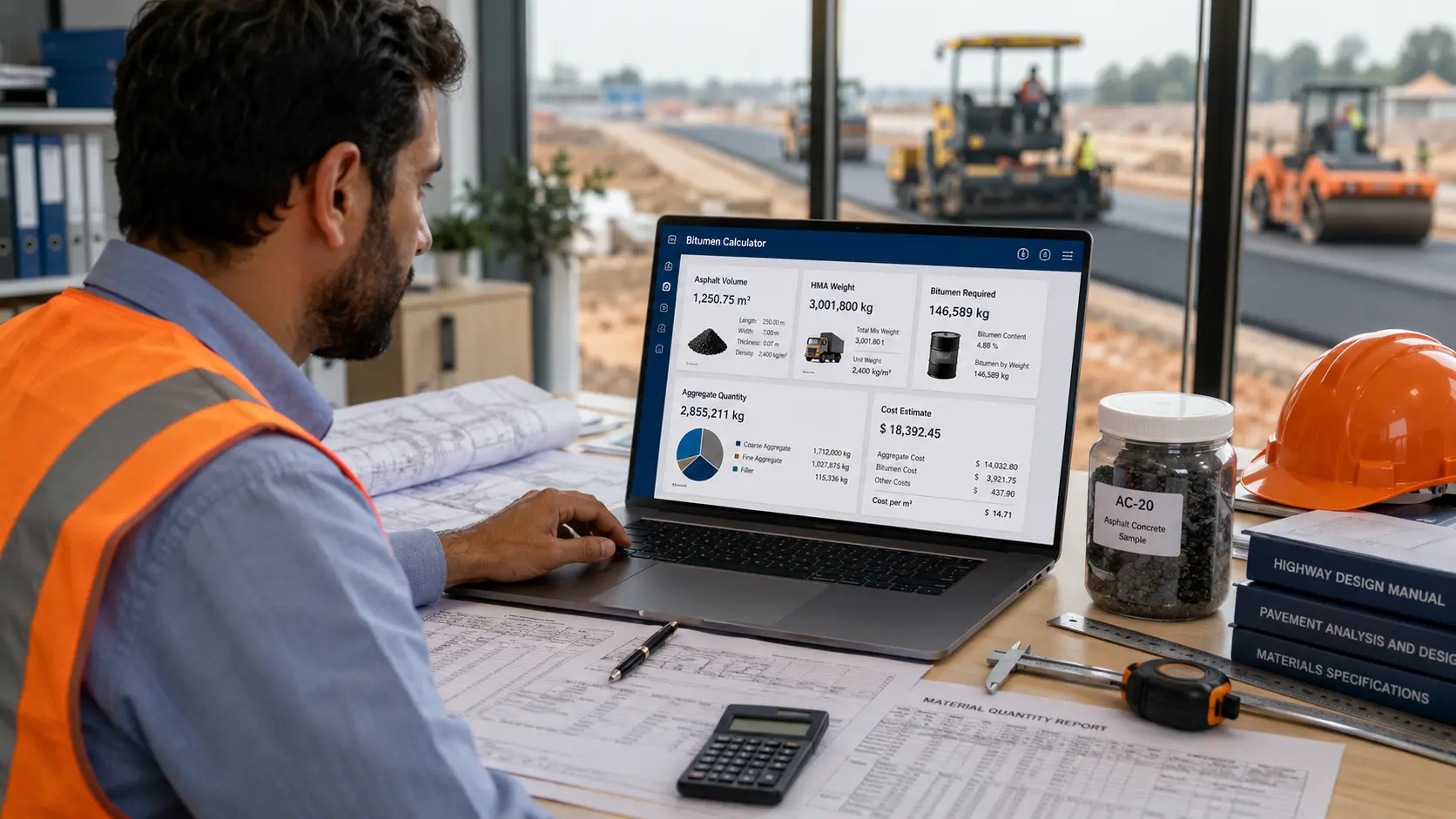
How to Use This Calculator
Using the Bitumen Calculator takes three simple steps. You don't need any software or manual formulas — just your project dimensions and mix data.
Enter Dimensions
Enter the length, width, and thickness of the pavement section you're working on. Thickness is usually the smallest number (often in millimetres), so double-check units before you calculate. See our Asphalt Layer Thickness Guide for standard depth recommendations.
Length: 1,000 m
Width: 3.5 m
Thickness: 50 mm
Select Units for Dimensions and Results
Our Bitumen Calculator allows users to select different measurement units based on project requirements. Users can enter pavement dimensions using suitable units, while the calculator automatically converts values internally to perform accurate calculations.
Using the correct units helps prevent calculation errors and ensures the final asphalt, bitumen, and aggregate quantities are displayed in the required format.
Enter Mix Properties (Density, Bitumen %)
Add the mix density (kg/m³) and the bitumen content percentage from your approved mix design. If you don't have a project-specific value, a typical reference range is fine for early-stage estimating.
Enter a price per unit for a budget figure. Advanced options are optional:
- Wastage allowance: adds 2-5% for site losses (order quantity).
- Compaction factor: converts compacted volume to loose volume. Enter 1.00 to skip.
- Binder density: converts bitumen kg to litres (default 1.03 kg/L).
Calculator Inputs at a Glance
| Input | Description | Supported Units |
|---|---|---|
| Length | Total pavement section length | m, ft, cm, mm, in, yd |
| Width | Pavement width | m, ft, cm, mm, in, yd |
| Thickness | Asphalt layer thickness | m, ft, cm, mm, in, yd |
| Mix Density | Weight of compacted HMA per cubic meter | kg/m³, lb/yd³, lb/ft³ |
| Bitumen Content | Binder percentage in total asphalt mix | % |
| Bitumen Price | Optional binder cost calculation | $/unit or local currency |
| Wastage Allowance | Extra % added to order quantity (typical 2-5%, default 0) | % |
| Compaction Factor | Loose volume ÷ compacted volume (1.00 = skip) | ratio |
| Binder Density | Pure bitumen density for litres (typical 1.02-1.04, default 1.03) | kg/L |
Bitumen Calculation Formula & Step-by-Step Method
This Bitumen Quantity Calculator uses standard pavement material estimation formulas to convert project dimensions and asphalt mix properties into total material requirements.
The calculation process follows four main steps. Each calculation uses the values entered by the user, including pavement dimensions, mix density, and bitumen content percentage.
Complete Bitumen Calculation Formula
For a quick estimate, the entire process can be combined into one calculation:
This formula helps estimate the approximate binder requirement for an asphalt pavement section. You can refer to our Bitumen & Asphalt Density Chart for standard job-mix values.
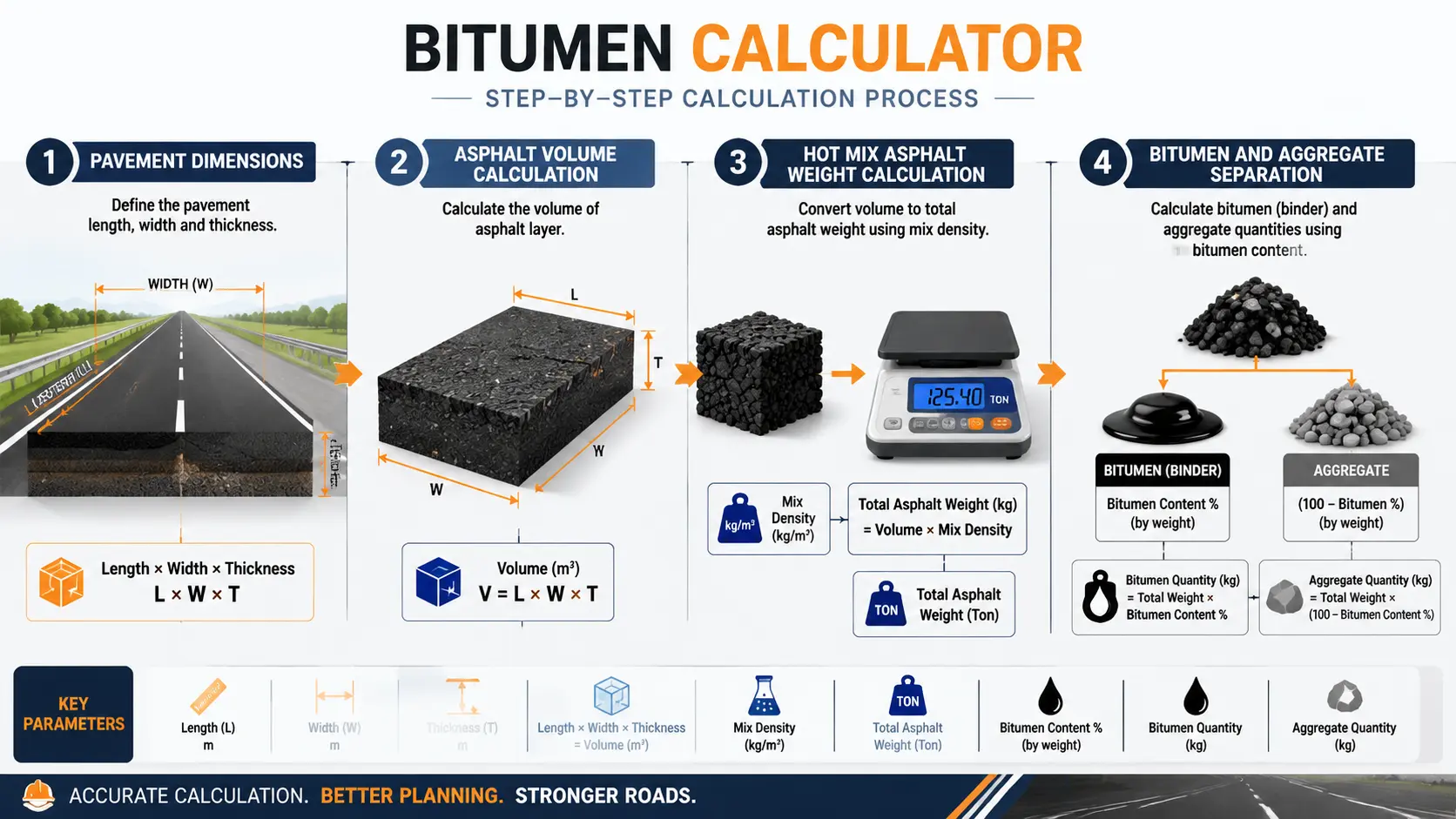
Step 1: Total Asphalt Volume
The first step is calculating the volume of the asphalt pavement layer.
Step 2: Total HMA Weight
After finding the pavement volume, the calculator converts the volume into total asphalt mixture weight using the HMA density.
Step 3: Bitumen Quantity
After finding Total Asphalt Weight our calculator then separates the bitumen portion from the total asphalt mixture. Bitumen content represents the percentage of binder contained within the total HMA weight.
Step 4: Aggregate Quantity
The remaining portion of the asphalt mixture is calculated as aggregate weight.
Bitumen Cost Calculation
The calculator can also estimate the approximate bitumen cost based on the calculated binder quantity.
The cost result is an estimate only. Actual prices may vary depending on supplier, location, bitumen grade, transportation, and market conditions.
All Bitumen Formulas at a Glance
A consolidated reference guide for civil engineers, site managers, and procurement teams.
L = Length (m), W = Width (m), T = Thickness (m)
ρ = Asphalt Mix Density (kg/m³)
B% = Bitumen % in Job Mix Formula (JMF)
⚠️ Standard HMA Compaction Factors range from 1.15 to 1.25; confirm with your local asphalt plant.
Worked Examples
Explore step-by-step worked examples for different project scenarios, from single roads and driveways to complex multi-layer highways.
Road Section (1 km)
Standard single-carriageway road section measuring 1,000 metres long by 3.5 metres wide with a 50 mm wearing course layer and 5.5% bitumen content.
Volume: 1,000 × 3.5 × 0.050 = 175 m³
Mix Weight: 175 × 2,350 = 411.25 tonnes
Net Bitumen: 411.25 × 0.055 = 22.62 tonnes
Order (+5% Wastage): 22.62 × 1.05 = 23.75 tonnes
Loose Volume (CF 1.20): 175 × 1.20 = 210 m³
Driveway (Metric)
Residential driveway measuring 15 metres long by 4 metres wide with a 40 mm asphalt layer and 5.5% bitumen content.
Volume: 15 × 4 × 0.040 = 2.4 m³
Mix Weight: 2.4 × 2,350 = 5,640 kg
Bitumen Weight: 5,640 × 0.055 = 310.2 kg
Volume of binder: 310.2 ÷ 1.03 ≈ 301 L (approx. 15 × 20 L drums)
Car Park with Wastage and Loose Volume
Commercial car park measuring 40 m × 25 m (1,000 m²) at 50 mm thickness, including 3% wastage and a compaction factor of 1.20.
Mix Weight: 1,000 m² × 0.050 × 2,350 = 117.5 tonnes
Net Bitumen: 117,500 kg × 0.055 = 6.46 tonnes (6,462.5 kg)
Order (+3% Wastage): 6.46 × 1.03 = 6.66 tonnes
Loose Volume: 50 m³ × 1.20 = 60 m³
Litres: 6,462 kg ÷ 1.03 ≈ 6,274 L (≈ 31 × 200 L drums)
Imperial Units Example
US highway section measuring 1 mile (5,280 ft) by 12 ft wide at 2 in thickness using 145 lb/ft³ mix density and 5.0% bitumen content.
Volume: 5,280 × 12 × (2 ÷ 12) = 10,560 ft³
Mix Weight: 10,560 × 145 = 1,531,200 lb (765.6 short tons)
Bitumen: 765.6 × 0.05 = 38.28 short tons
Metric Conversion: 38.28 × 907.185 kg ≈ 34,727 kg ≈ 34.7 tonnes
Multi-Layer Highway
Most highway pavements consist of three distinct courses (base course, binder course, wearing course), each with a specific thickness and binder content. Calculating them separately gives a more accurate estimate.
3-Layer Pavement Worked Example (1 km × 3.5 m)
| Layer | Thickness | Bitumen % | Mix Weight | Bitumen Weight |
|---|---|---|---|---|
| Base course | 75 mm | 4.0% | 616.9 t | 24.7 t |
| Binder course | 50 mm | 4.5% | 411.3 t | 18.5 t |
| Wearing course | 40 mm | 5.5% | 329.0 t | 18.1 t |
| Total bitumen required across all three layers: | ≈ 61.3 t | |||
With 5% wastage: 61.3 t × 1.05 = 64.4 t order quantity. Always add a wastage allowance (2–5%) before placing your procurement order.
Quick Lookup Tables
Use these quick reference tables for rapid material estimation across typical road dimensions and mix binder ratios.
Bitumen Required for a 1 km Road
Road dimensions: 1 km (1,000 m) length × 3.5 m width, mix density 2,350 kg/m³. Values are tonnes of bitumen binder.
| Thickness | Mix (t) | Bitumen Content (% & Tonnes Required) | |||
|---|---|---|---|---|---|
| 4.5% | 5.0% | 5.5% | 6.0% | ||
| 30 mm | 246.75 | 11.10 | 12.34 | 13.57 | 14.81 |
| 40 mm | 329.00 | 14.81 | 16.45 | 18.10 | 19.74 |
| 50 mm | 411.25 | 18.51 | 20.56 | 22.62 | 24.68 |
| 75 mm | 616.88 | 27.76 | 30.84 | 33.93 | 37.01 |
| 100 mm | 822.50 | 37.01 | 41.13 | 45.24 | 49.35 |
Bitumen per Tonne of Asphalt
Bitumen and aggregate weight breakdown per 1 tonne (1,000 kg) of total asphalt mix.
| Bitumen Content (B%) | Bitumen Weight | Aggregate Weight |
|---|---|---|
| 4.5% | 45 kg | 955 kg |
| 5.0% | 50 kg | 950 kg |
| 5.5% | 55 kg | 945 kg |
| 6.0% | 60 kg | 940 kg |
| 6.5% | 65 kg | 935 kg |
Pavement Engineering Concepts
Understand essential engineering concepts behind mix densities, volume shrinkage, liquid binder conversions, and coat applications.
Mix Density vs Binder Density
This is one of the most common sources of ordering errors, because both numbers look similar but do completely different jobs.
- Mix density (roughly 2,200–2,450 kg/m³) is the weight of the finished asphalt mixture — bitumen plus aggregate plus filler — per cubic metre. This calculator uses mix density to turn your pavement volume into total mix weight.
- Bitumen (binder) density (roughly 1,020–1,040 kg/m³) is the weight of pure bitumen alone, before it's mixed with anything. This number matters when you're converting a bitumen weight into a volume — for example, working out how many litres or drums of binder to order.
Rule of thumb:
Use mix density for volume-to-weight conversions of the whole asphalt layer. Use binder density only when converting the bitumen portion into litres or drums.
Loose Volume vs Compacted Volume
Asphalt volume isn't fixed — it changes depending on whether the material is loose (as delivered/laid, before rolling) or compacted (after rolling, the finished in-place layer).
Hot mix asphalt contains air voids when it's freshly laid. Compaction rollers press the aggregate particles closer together and drive out much of that air, reducing the volume the material occupies.
Loose asphalt volume is generally higher than compacted volume, because compaction removes air voids that are present when the mix is freshly laid. The exact difference depends on the mix design, temperature, and compaction requirements.
Converting Bitumen Weight to Litres and Drums
Bitumen is often specified by weight (tonnes) in mix design but purchased or transported by volume (litres or drums), so this conversion comes up constantly in procurement. To calculate horizontal cylinder tank capacity, partial dip depth, or thermal volume expansion at working temperatures, use our dedicated Bitumen Tank Volume Calculator.
Using a typical binder density of approx 1.03 kg/L:
| 20 L drum | ≈ 20.6 kg |
| 200 L drum | ≈ 206 kg |
Bitumen Calculator vs Spray Application Calculator
These two calculations are often confused because both involve "how much bitumen," but they solve different problems.
What Affects Bitumen Price
Understanding market dynamics and pricing variables
Bitumen pricing isn't fixed the way a manufactured product's list price might be — it fluctuates for several structural reasons:
Bitumen is a heavy refinery by-product, so its baseline cost tracks global crude oil market benchmarks to a significant degree.
Penetration grades, VG, and PG bitumen carry different refining costs. Polymer-modified binders (PMB) command a further price premium.
Proximity to coastal refineries, import tariffs, regional supply constraints, and local infrastructure demand all shift regional pricing.
Bulk liquid tanker deliveries offer typically lower per-tonne pricing compared to heated intermediate bulk containers or small drummed supplies.
Bitumen vs Asphalt vs Tar vs Tarmac
These four terms get used interchangeably in everyday speech, but in civil engineering, they mean different things:
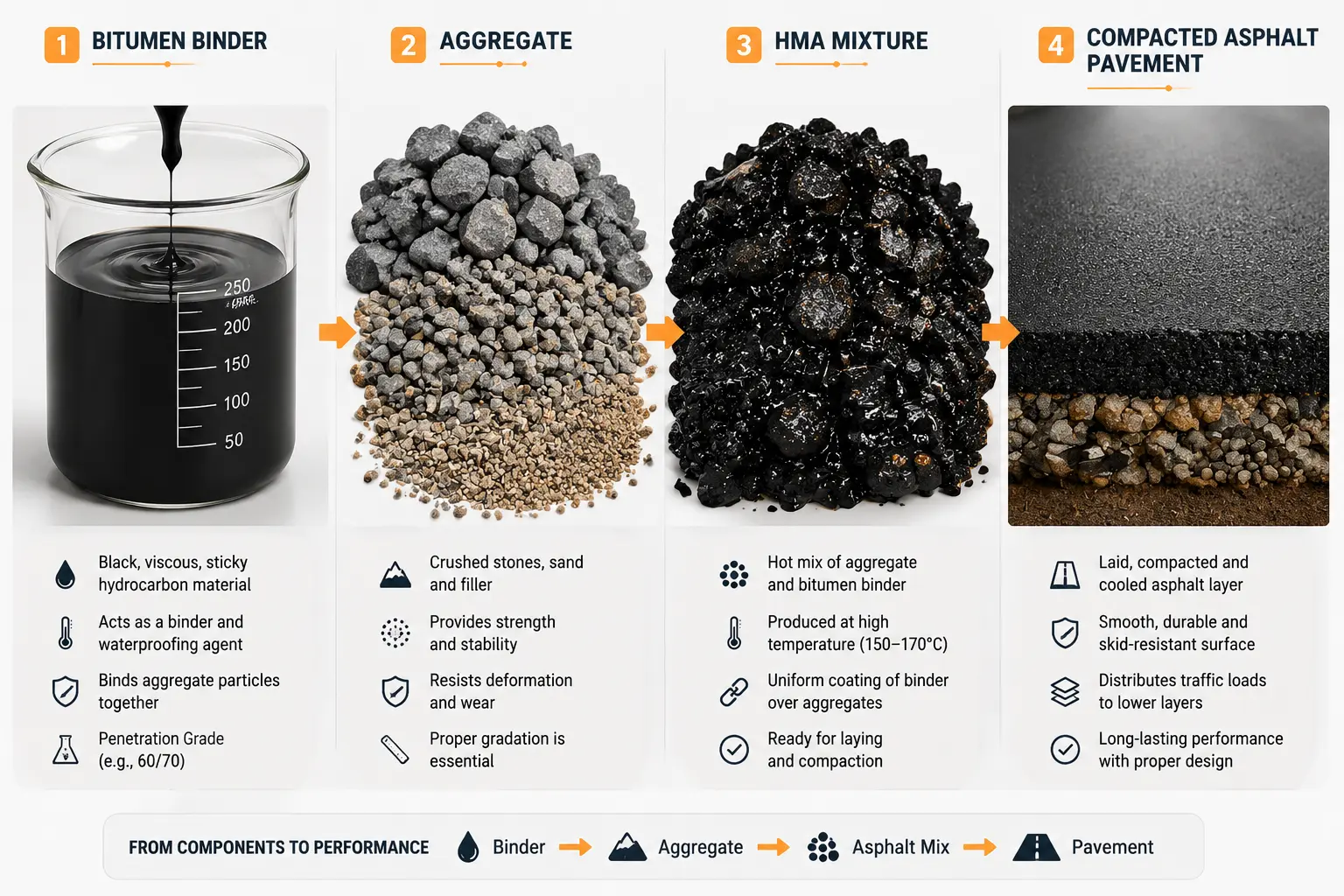
Bitumen
The black, sticky binder itself, derived from crude oil refining. It's an ingredient, not a finished road surface. Curious about properties and grades? Read our full guide on What is bitumen?.
Asphalt
The finished mixture of bitumen binder and mineral aggregate, laid and compacted to form the pavement layer. While hot mix is standard for construction, cold mix bitumen is often used for quick repairs without heating equipment. Pavement depth varies widely by application.
Tar & Tarmac
Tar — a similar-looking black binder, but derived from coal rather than petroleum. Tar was used historically in road construction and is now largely phased out in most modern paving due to health and environmental concerns.
Tarmac— short for "tar-bound macadam," a historical road-surfacing method. The word has stuck around colloquially to mean any paved road surface, even though modern pavements are almost always bitumen-based asphalt.
Where Is Bitumen Calculation Used?
From residential driveways to motorways and industrial port aprons, bitumen quantity estimation is needed across every pavement category.
- Municipal road resurfacing and patch repairs
- Rural sealed road construction with base and wearing courses
- Kerb-to-kerb bitumen quantity takeoffs for council contracts
- Multi-lane carriageway paving with separate layer calculations
- SMA and PMB mixes for high-speed, high-traffic surfaces
- Pavement rehabilitation & RAP estimation (calculate millings with our Asphalt Millings Calculator)
- Retail and commercial car park surface estimation
- Petrol station forecourt dense-graded HMA quantities
- Airport apron and taxiway binder course calculation
- Thin wearing course for pedestrian paths (30–40 mm layers)
- Shared cycle and footway combined bitumen estimates
- Urban trail networks with open-graded friction course mixes
- Residential driveway surface and base course quantities
- Private estate roads with varying layer configurations
- Complete paving budget estimates (use our Asphalt Driveway Cost Calculator)
- Heavy-duty yard paving for logistics centres and warehouses
- Port terminal apron: thick base course, PMB wearing course
- Mining haul roads: high-density mix design, bitumen per tonne
Typical Bitumen Content by Mix Type
(Reference Table)
General purpose paving — roads, highways, and driveways.
High-traffic highways with excellent rut resistance.
Highway surface drainage and noise reduction layer.
Heavy-duty — airports, industrial areas, bus terminals.
- Traffic loading & mix design — heavy traffic requires stiffer binder grades or specialized stone-matrix mixes (SMA) with polymer modification to prevent rutting and permanent deformation.
- Climate — hotter regions may need modified binders or adjusted content to avoid softening.
- Aggregate grading — finer gradations generally need more binder to coat the increased surface area.
None of these figures replace an approved, lab-verified mix design for the actual project.
Optimum Bitumen Content & Mix Design Methods
A reference table gives a starting range, but the actual percentage used on a project comes from a formal mix design process that determines the Optimum Bitumen Content (OBC).
Marshall Method
Compacts trial mixes at several bitumen percentages, then tests stability and flow to find the percentage that best balances strength, density, and air voids. It remains widely used, particularly in South Asia and parts of the Middle East.
Superpave Method
A performance-based approach developed in the US that considers traffic level, climate, and aggregate properties using gyratory compaction rather than impact compaction, aiming to better predict long-term field performance.
A reference table can guide early estimating, but only lab-tested OBC — derived from the specific aggregate source, binder grade, and traffic condition of the project — should be used for final construction quantities.
Industry Standards & References
Bitumen calculator results are only as good as the mix design inputs behind them. These are the standards that govern how bitumen content, mix density, and volumetric properties are determined, tested, and specified.
Mix Design Methods for Asphalt
Provides guidance for Marshall and Superpave mix design procedures, establishing optimum binder content ranges.
Bulk Specific Gravity of Compacted Mix
Standard laboratory test method measuring the bulk density of compacted asphalt specimens for tonnage calculations.
Specific Gravity of Liquid Bitumen
Standard test method for determining the specific gravity and liquid density of bitumen binders used for litres conversion.
HMA Production & Paving Standards
National Asphalt Pavement Association technical guidelines for hot-mix asphalt plant production, job-mix formulas, and US site paving practices.
Always verify that the edition of any standard in force in your jurisdiction matches the mix design data you are entering into the calculator.
Who Uses BitumenCalcPro?
BitumenCalcPro gives pavement professionals a transparent, formula-driven estimate — helping contractors and engineers avoid asphalt estimation mistakes, manage site maintenance, and understand how project budgeting and bitumen driveway cost drive project requirements.
- Civil & site engineers — preliminary quantity takeoffs and project planning.
- Road contractors & estimators — fast binder and aggregate figures for tendering and procurement.
- Quantity surveyors — early-stage cost modelling before lab-tested values are available.
- Engineering students — understanding how mix density, bitumen percentage, and pavement geometry interact.
Conclusion
Estimating bitumen and aggregate quantities doesn't need to involve manual formula work every time — but understanding what's behind the numbers matters, especially where mix density, binder density, and compaction factors are easy to mix up.
Used alongside an approved mix design, this calculator gives a fast, transparent way to plan pavement material quantities before committing to a final order.
Frequently Asked Questions
What is the formula for calculating bitumen quantity?
To find the bitumen quantity, first calculate the total asphalt volume (Length × Width × Thickness in metres), then convert to weight using the mix density, then apply the bitumen content percentage. The single combined formula is: Bitumen (kg) = L × W × T × Density × (B% ÷ 100).
What inputs do I need to estimate asphalt materials?
You'll need: pavement dimensions (length, width, thickness), the compacted HMA mix density (typically 2,200–2,450 kg/m³), and the target bitumen content percentage from your mix design (usually 4–6.5%). For ordering, also add a 2–5% wastage allowance.
How do I know what bitumen percentage to use?
The exact percentage must come from a lab-approved mix design for your project. As planning estimates: dense-graded wearing courses typically use 5.0%–6.0% (up to 6.0%–7.0% for SMA/PMB), binder courses 4.5%–5.5%, and base courses 4.0%–5.0%. Always confirm with your supplier before final ordering.
What density should I use in a bitumen calculator?
Use the compacted HMA mix density, not the pure bitumen binder density. Dense-graded asphalt mixes typically range from 2,200 to 2,450 kg/m³. Pure bitumen density (≈1.03 kg/L or ≈1,030 kg/m³) is only used when converting bitumen weight to litres.
How do I convert my pavement volume into tonnes?
Multiply total pavement volume (m³) by the compacted mix density (kg/m³), then divide by 1,000 to get tonnes. Example: 175 m³ × 2,350 kg/m³ = 411,250 kg = 411.25 t.
Why should I add a wastage factor to my bitumen calculation?
Allowances of 2–5% are commonly used to account for site losses, uneven subgrade, edge trimming, and transport loss. For example: 22.62 t net × 1.05 = 23.75 t order quantity.
What is the compaction factor for Hot Mix Asphalt (HMA)?
The compaction factor is the ratio of loose mix volume to compacted in-place volume. Commonly used planning values are about 1.15-1.25; it varies by mix and site. Loose volume = Compacted volume × Compaction factor.
How do I convert bitumen weight to litres and drums?
Divide bitumen kg by the pure binder density (typically 1.03 kg/L). Example: 22,620 kg ÷ 1.03 ≈ 21,961 L. To find drums: Litres ÷ 200 for 200 L drums, or Litres ÷ 20 for 20 L drums.