
Quick Answer
How to pronounce asphalt: say AS-fawlt. It has two syllables, and the stress lands on the first. The “ph” sounds like “f,” and the last syllable rhymes with “salt.” Many Canadians say ASH-falt, and dictionaries accept that version too. British speakers often say AS-falt, with a shorter second vowel. The spelling is a-s-p-h-a-l-t.
You've read the word a hundred times, and then someone hands you a microphone. Is it AS-fawlt, ASH-falt, or something else?
If you searched how do you say asphalt or how to spell asphalt, you'll find both answers here, along with the reasons the word gets said three different ways. This guide covers the standard pronunciation, regional versions, spelling tricks, the history behind the “ph,” and how to pronounce the related words you meet in road work, such as bitumen, tarmac, and macadam. You'll also get practice sentences and clear rules for which version to use in which situation.
How to Pronounce Asphalt, Step by Step
Take the word one piece at a time.
Start with 'AS'
Move straight into 'F'
Finish with 'AWLT'
Stress the first syllable
Say it slowly three times, then at normal speed. The whole word takes about a second.
If you want a rhyme check, “fawlt” sounds the same as the end of “default” and “assault.” The first half, “AS,” is the same as the word “as.”
Reading the Dictionary Symbols
Dictionaries write pronunciation in special symbols, and they can look confusing. Here is how to read them for asphalt.
- /ˈæs.fɔlt/is the common American transcription. The small mark before the first syllable shows where the stress goes. The symbol “æ” is the short “a” in “cat.” The symbol “ɔ” is the “aw” in “law.” So you read it as AS-fawlt.
- Merriam-Webster respelling: ˈas-ˌfȯlt. The ȯ symbol is the same “aw” sound. You can check the native sound recording on the Merriam-Webster asphalt dictionary entry .
- British transcription: often written with a shorter vowel in the second syllable, close to AS-falt, as listed in the Cambridge Dictionary .
You don't need to memorize any of these. The respelling AS-fawlt is enough for everyday use, and it matches what most dictionary audio clips play.
Asphalt Pronunciation by Region
The word has one spelling and a few common sounds. This table shows the main versions.
| Region or accent | Common sound | What changes |
|---|---|---|
| General American | AS-fawlt | Long 'aw' in the second syllable |
| British English | AS-falt | Shorter vowel in the second syllable |
| Canadian (very common in Ontario and the Great Lakes area) | ASH-falt | The first syllable starts with 'sh' |

Merriam-Webster lists AS-fawlt as the main pronunciation. It also records “ash” as an accepted alternative and describes the British ending as an especially British form. That means all three versions have dictionary support.
Many Canadians say ASH-falt, including engineers and road crews. An engineer who moved to Canada once asked an engineering forum about it after hearing “ash-falt” on a work site. Replies from people in that field said the pronunciation is common around the northern Great Lakes and in Canada. Several mentioned that colleagues with advanced degrees in the field say it that way too.
So the “ash” version belongs to educated, professional speech in those places. It is not a mistake or a sign of an uneducated speaker.
Why Does “Ash-falt” Exist?
Nobody has a settled answer, and I won't pretend there is one. What the record shows is that the “ash” version is old.
A linguist posting to the American Dialect Society mailing list pointed to printed spellings of “ashpalt” from 1900 and 1907. The playwright Eugene O'Neill also wrote it as “ashpalt” in a 1918 script. A comic song from the late 1800s or early 1900s used a similar spelling too.
Those spellings suggest people were saying “ash” more than a hundred years ago. The same discussion noted that the pronunciation is not limited to Canada. Speakers in other places use it as well, and one forum poster said it is common in South Africa.
The practical takeaway: if you hear ASH-falt, nobody is confused. It's a regional habit with a long history.
How to Spell Asphalt
The spelling is a-s-p-h-a-l-t. That's 7 letters across 2 syllables: as-phalt.
The hard part is the “ph” in the middle. Many people want to write an “f” because that's what they hear. English uses “ph” for the “f” sound in words that came from Greek, and asphalt is one of them.
Here are the spellings people type by mistake:
- asfalt (the “f” replaces “ph”)
- ashpalt (the letters swap places after “as”)
- asphault (an extra “u,” copied from “fault”)
- aspalt (the “h” goes missing)

Two memory tricks can help:
1. Split it as “asp” + “halt.”An asp is a snake, and “halt” means stop. The word sits together as asp-halt.
2. Link the “ph” to other Greek-origin words.Phone, photo, pharmacy, and phase all use “ph” for the same “f” sound.
If you write for a living, set your spellchecker to flag “asphault.” It's the most common slip because “fault” is a word people already know.
The word is spelled the same in British, American, and Canadian English. Some other languages spell it differently or use a different word, but in English there is one form.
Where the Word Asphalt Comes From
Asphalt came into English through Medieval Latin asphaltus, which came from Greek asphaltos. The first known English use is from the 14th century, according to Merriam-Webster.
The earliest meaning was the natural black pitch that seeps out of the ground in some parts of the world, especially around the Middle East. That is a long way from a modern paving crew, but the material is closely related. Today most asphalt binder comes from refining crude oil.
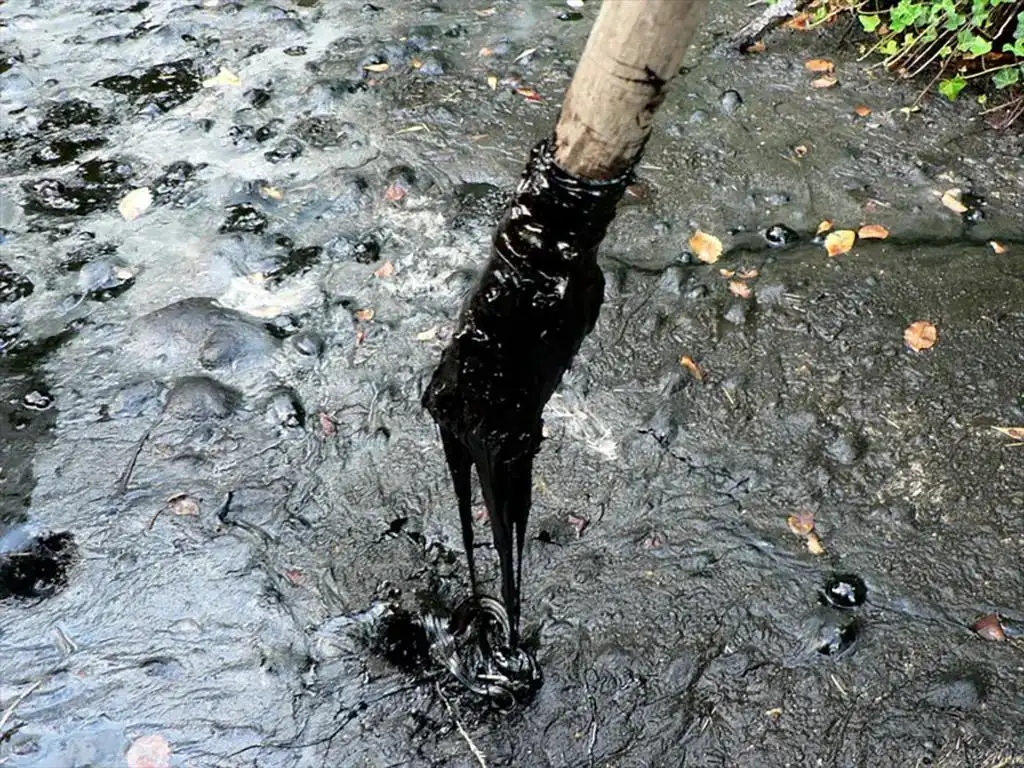
One explanation links the Greek word to a prefix meaning “not” and a verb meaning “to cause to fall,” because the sticky material was used to hold walls together. Sources describe this origin as a possibility, so treat it as a theory.
The Greek spelling also explains the “ph.” The letter phi became “ph” in Latin, and English kept it.
Construction Terms That Travel With Asphalt
If you work around roads, you'll say these words next to asphalt every day.

Bitumen: buh-TOO-men / BIT-yoo-men
American dictionaries give buh-TOO-men. British English commonly says BIT-yoo-men or BICH-uh-men. All three are in use, so match the people around you. For a complete guide, read how to pronounce bitumen.
Tarmac: TAR-mak
TAR-mak. It is short for “tar macadam.”
Macadam: muh-KAD-um
muh-KAD-um. The word comes from the name of the Scottish engineer John Loudon McAdam, who developed an early method of building roads from compacted stone.
Aggregate: AG-ruh-git
AG-ruh-git. The crushed stone and sand mixed with the binder.
HMA: H-M-A
Say the letters H-M-A. It stands for hot mix asphalt.
Tack coat: TAK coat
TAK coat. A thin layer of binder sprayed between pavement layers.
Wearing course: WAIR-ing course
WAIR-ing course. The top layer of a pavement.
Asphalt, Bitumen, Tar, and Concrete: What Each Word Means
These words get mixed up in everyday talk, and the meaning also changes by country. Getting them right helps both your speech and your writing.
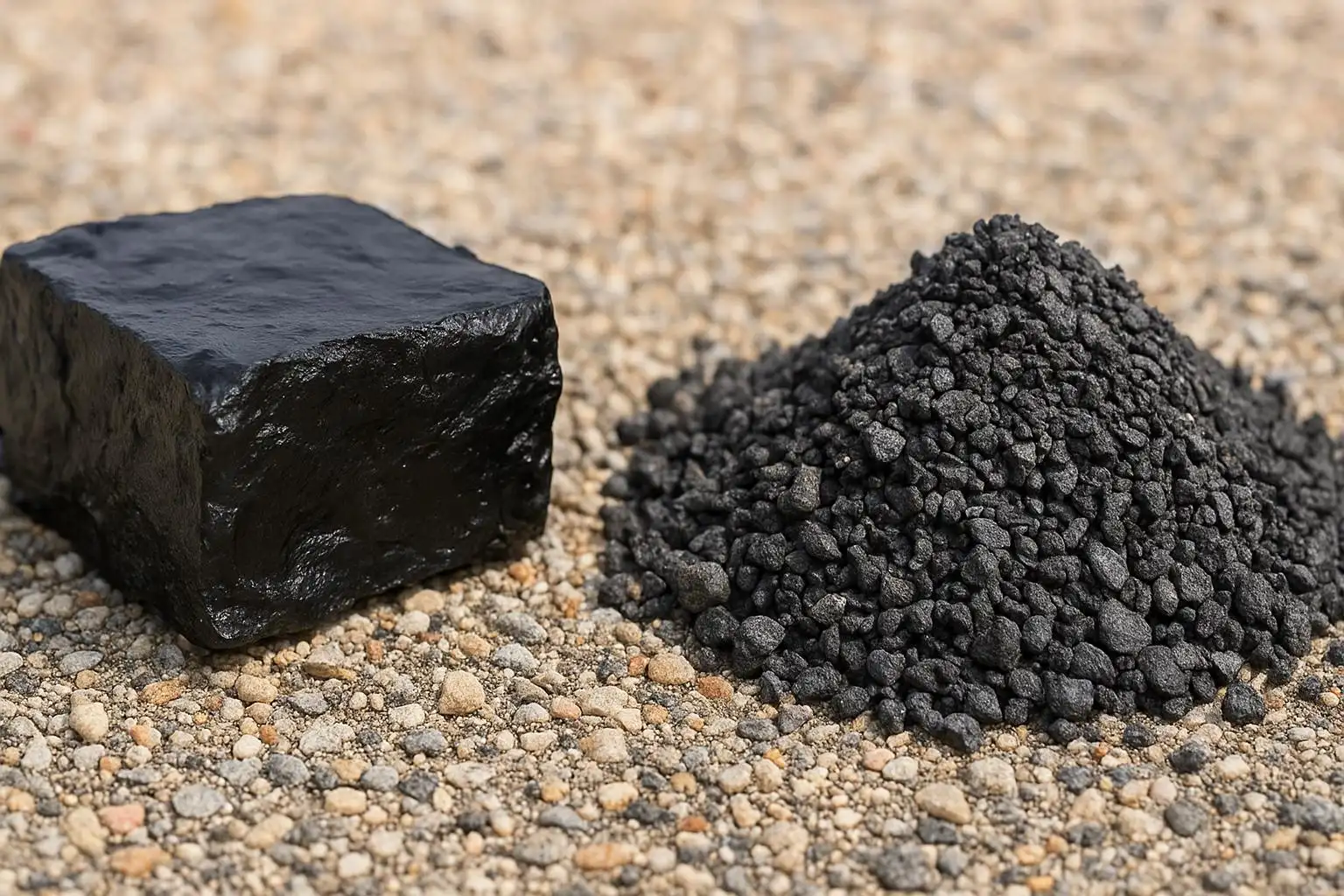
Bitumenis the thick, black, sticky binder. It comes from crude oil refining or from natural deposits. In the UK, Pakistan, India, and many other countries, “bitumen” is the word for this binder. A specification might call for a “60/70 penetration grade bitumen,” where the numbers describe how soft the binder is.
Asphalt is the finished paving mix in most of the world. It combines bitumen with aggregate (stone, gravel, and sand). In the United States, people often say “asphalt” for both the binder and the mix. The binder there may also be called asphalt cement or asphalt binder. Read our complete asphalt vs bitumen comparison for the regional differences.
Tarmacis a common everyday word in Britain and Ireland for an asphalt road surface. It comes from “tar macadam.”
Taris a different material. It comes from distilling coal or wood, not from crude oil. People sometimes call asphalt roads “tar roads,” which is common speech and not technically accurate.
Concrete uses cement as its binder, not bitumen. It is paler, stiffer, and has a different surface texture. Compare their performance in our guide on asphalt vs concrete.
Here is an example of why the difference matters:
A road estimate that lists “bitumen” in tonnes is counting the binder only. A line that lists “asphalt” in tonnes is counting the full mix, which weighs far more. Mixing up the two words can throw off a quantity calculation. You can calculate precise project volumes and weights with our free Bitumen and Asphalt Calculator.
Common Pronunciation Mistakes
These are the slips I hear and see most often:
- Adding an extra vowel: saying “as-uh-falt.” The word has only two syllables.
- Saying the “p” on its own: saying “as-p-halt.” The “ph” together makes one “f” sound.
- Stressing the second syllable: saying as-FAWLT. Keep the push on the first syllable.
- Dropping the final “t”: saying “asfaw.” Finish the word with a clear “t.”
- Mixing the vowel with “ash”: saying “ash-fawlt” in an area where “ash-falt” or “AS-fawlt” would be expected. The two parts usually come as a matched set.
Tips for Learners and Non-Native Speakers
Some languages don't allow the consonant pairing “sf” in the middle of a word. Speakers of those languages sometimes add a small vowel to break it up. In asphalt that gives you “as-uh-falt.”
Try this drill:
- Say “as.” Hold the “s” sound for a moment.
- Without adding any vowel, slide the “s” into “f.”
- Add “awlt.”
- Speed up until it feels like one word.
Record yourself on your phone and play it back. Compare it with an audio clip from a trusted dictionary. The recording will show you whether a hidden vowel crept in.
Practice with these sentences:
“The crew laid fresh asphalt before the rain.”
“The asphalt plant opens at six.”
“They will asphalt the parking lot next week.”
“Hot asphalt was spread over the old road surface.”
“The bitumen and aggregate go into the asphalt mixer.”
Read them out loud, slowly first and then at natural speed. Whether you are performing routine asphalt driveway sealcoating or using cold mix bitumen for patching, clear pronunciation builds confidence on site.
Which Pronunciation Should You Use?
Match your audience.
Teaching, recording, or presenting to a mixed audience
Use AS-fawlt. It is the most widely recognized version.
Working in Canada or with Canadian colleagues
ASH-falt will sound natural, and nobody will notice it.
Working in the UK or Ireland
AS-faltis the common version, and “tarmac” often replaces the word in casual speech.
Writing
Always spell it a-s-p-h-a-l-t. Pronunciation varies, but the spelling does not.
Conclusion
Say AS-fawlt: two syllables, stress on the first, “ph” as “f,” and a clear “t” at the end. ASH-falt is common in Canada, and AS-falt is common in Britain. All three have dictionary support. Spell the word a-s-p-h-a-l-t, and use the “asp + halt” trick if the “ph” trips you up.
When you move from the word itself to road work and driveway repair, keep the vocabulary straight. Bitumen is the binder, asphalt is usually the mix, tarmac is a British word for the surface, and tar is a separate material.
Frequently Asked Questions
How do you say asphalt?
Say AS-fawlt. It has two syllables, the stress is on the first, and the second rhymes with 'salt.'
Is 'ash-falt' an incorrect pronunciation?
No. Dictionaries list it as an accepted variant. Many Canadians use it every day, and printed spellings suggest it has been around for over a century.
How many syllables are in asphalt?
Two: as-phalt.
Is the 'ph' in asphalt silent?
No. It makes an 'f' sound. Only the 'p' is not heard separately.
Why is asphalt spelled with 'ph'?
The word came from Greek through Latin. Greek phi became 'ph' in Latin, and English kept the spelling.
How do you spell asphalt?
a-s-p-h-a-l-t. Common misspellings include 'asfalt,' 'ashpalt,' 'asphault,' and 'aspalt.'
What is the difference between asphalt and bitumen?
Bitumen is the black, sticky binder. In most countries, asphalt is the paving mix made from bitumen plus stone, gravel, and sand. In the United States, 'asphalt' can mean either one.
Is tarmac the same as asphalt?
Tarmac is a common British and Irish word for an asphalt road surface. It comes from 'tar macadam.'
Does the verb 'to asphalt' sound different?
No. It is pronounced AS-fawlt in the same way as the noun.
How do you pronounce asphaltic?
Say as-FAWL-tik. The stress moves to the second syllable.

Founder & Web Developer
Nabeel Awan is a web developer and the founder of BitumenCalcPro. His work focuses on web development and building practical online tools, with a strong interest in civil engineering, asphalt, bitumen, pavement construction, and construction technology.