
Quick Answer
How to pronounce bitumen depends on your accent. British English says BICH-uh-mun, with stress on the first syllable. American English says buh-TOO-mun or bye-TOO-mun, with stress on the second. Both have 3 syllables, and the unstressed vowels shrink to a soft “uh.”
Pick one accent, say it the same way every time, and people will understand you on any job site or in any classroom.
You see the word on road signs, roofing labels, and oil news. Then someone asks you to say it out loud, and you're not sure which syllable to hit. Dictionaries list more than one pronunciation, and each one is right for its own accent.
This guide covers how to pronounce bitumen in British, American, Australian, and other English accents. You'll get respellings, IPA symbols, stress patterns, common mistakes, related technical words, and a practice routine. The forms below come from Cambridge Dictionary and Merriam-Webster .
Bitumen Pronunciation at a Glance
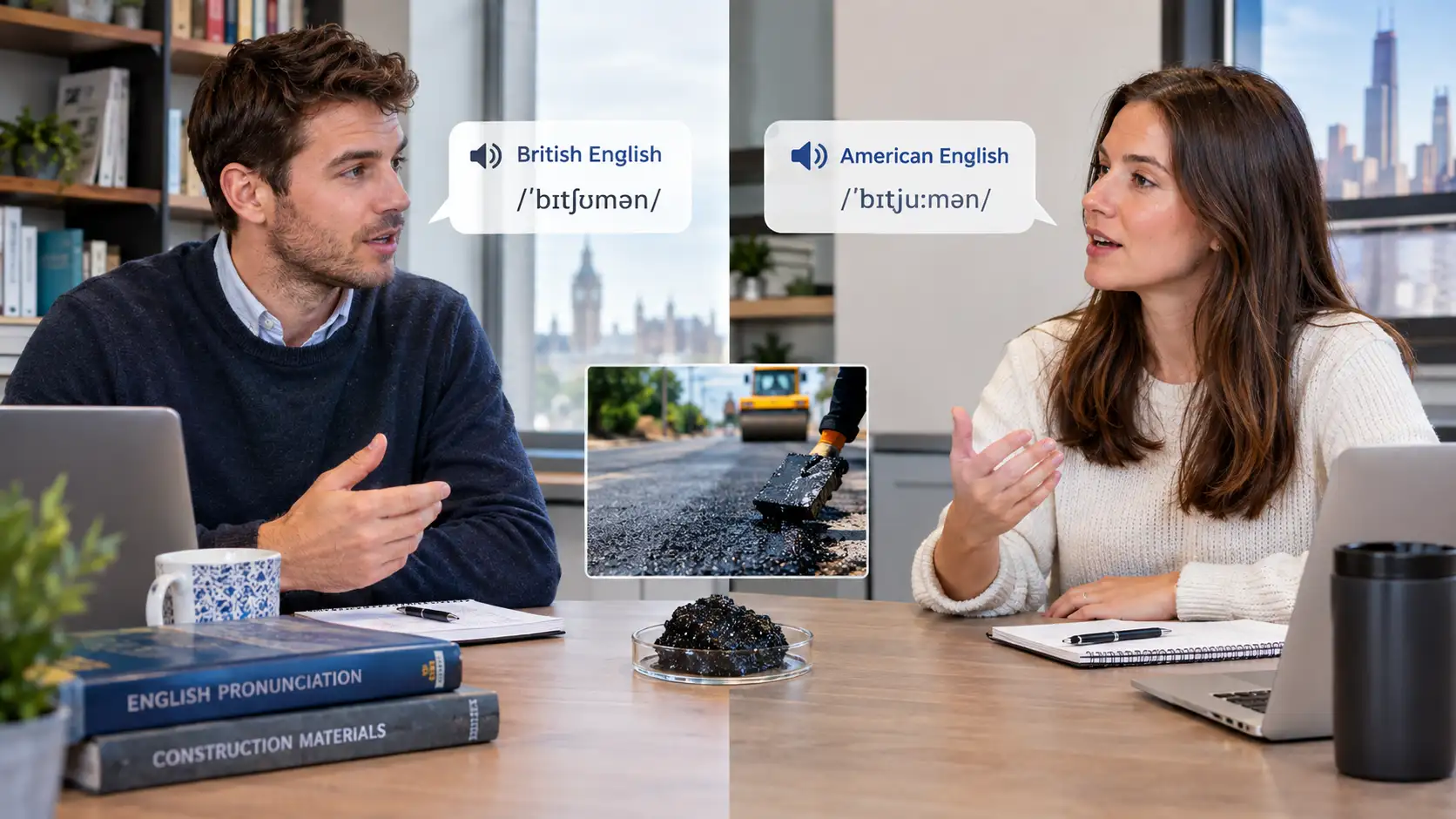
| Accent | Simple respelling | IPA | Stressed syllable |
|---|---|---|---|
| British (common) | BICH-uh-mun | /ˈbɪtʃ.ə.mən/ | 1st |
| British (alternate) | BIT-yuh-mun | /ˈbɪtjʊmən/ | 1st |
| American (Cambridge) | bye-TOO-mun | /baɪˈtuː.mən/ | 2nd |
| American (Oxford) | bih-TOO-mun | /bɪˈtuːmən/ | 2nd |
| American (Merriam-Webster) | buh-TYOO-mun | /bəˈtjuːmən/ | 2nd |
Capital letters mark the stressed syllable. You don't need to say it louder — make it slightly longer and clearer than the other two syllables.
Every form above has 3 syllables. The differences are the stress, the first vowel, and the middle consonant. Merriam-Webster also lists a “bye” opening and a “TOO” version without the “y” glide, so you'll find several American forms across sources.
British English: BICH-uh-mun
Cambridge lists the UK pronunciation as /\u02c8b\u026at\u0283.\u0259.m\u0259n/. It's the form most people mean when they say “the British pronunciation.”

Step-by-Step
It rhymes with 'rich' and 'which.' This is the stressed beat.
This is the schwa — the vowel in the first syllable of 'about.' Keep it quick.
The lips close for the 'm,' and the tongue tip touches the ridge behind your top teeth for the 'n.'
BICH-uh-mun. The first syllable takes the beat. The other two are quick and quiet.
The 'BIT-yuh-mun' variant
Merriam-Webster marks a form beginning 'BIT-yuh' as especially British. Both British forms put stress on the first syllable. The 'ch' comes from 't' and 'y' merging when spoken quickly — linguists call this yod coalescence. The same merger appears in some British pronunciations of 'Tuesday' (CHOOZ-day) and 'tune' (CHOON).
American English: buh-TOO-mun and Its Variants
American sources don't agree on one form, but all share one thing: the stress is on the second syllable.

The first vowel is the 'eye' sound. The middle is a clear 't' followed by the long 'oo' of 'blue.' The last syllable is weak.
The first vowel is the short 'i' of 'bit.' This version sounds close to the British first vowel, with American stress.
A weak 'buh' at the start and a small 'y' glide in the middle. Rhymes with 'human' in the last two syllables.
Why Americans usually drop the “y”
Many American accents drop the “y” glide after “t,” “d,” and “n.” So “tune” becomes TOON, “Tuesday” becomes TOOZ-day. That's why you hear TOO and not CHOO or TYOO.
If you want one form to memorize, choose buh-TOO-mun. Canada generally follows the same second-syllable pattern — buh-TOO-mun is a safe choice there too.
Australia, New Zealand, and South Asia
Australia
Australians use the word daily, and in informal speech it names a sealed road surface. Both BICH-uh-mun and BIT-yuh-mun are common, with first-syllable stress typical of British-type accents.
New Zealand
No major dictionary records a separate NZ pronunciation. NZ English is close to British and Australian patterns, so first-syllable stress is the standard choice.
India & Pakistan
English in South Asia generally follows British conventions. BICH-uh-mun matches the British model. Check a recording before using it in a formal presentation.
Canada
Second-syllable stress is the most common pattern in Canadian broadcasts about Alberta's oil sands. buh-TOO-mun is a dependable Canadian-sounding choice.
The Sounds Broken Down (IPA)
The International Phonetic Alphabet gives each speech sound its own symbol, avoiding the problems of English spelling.
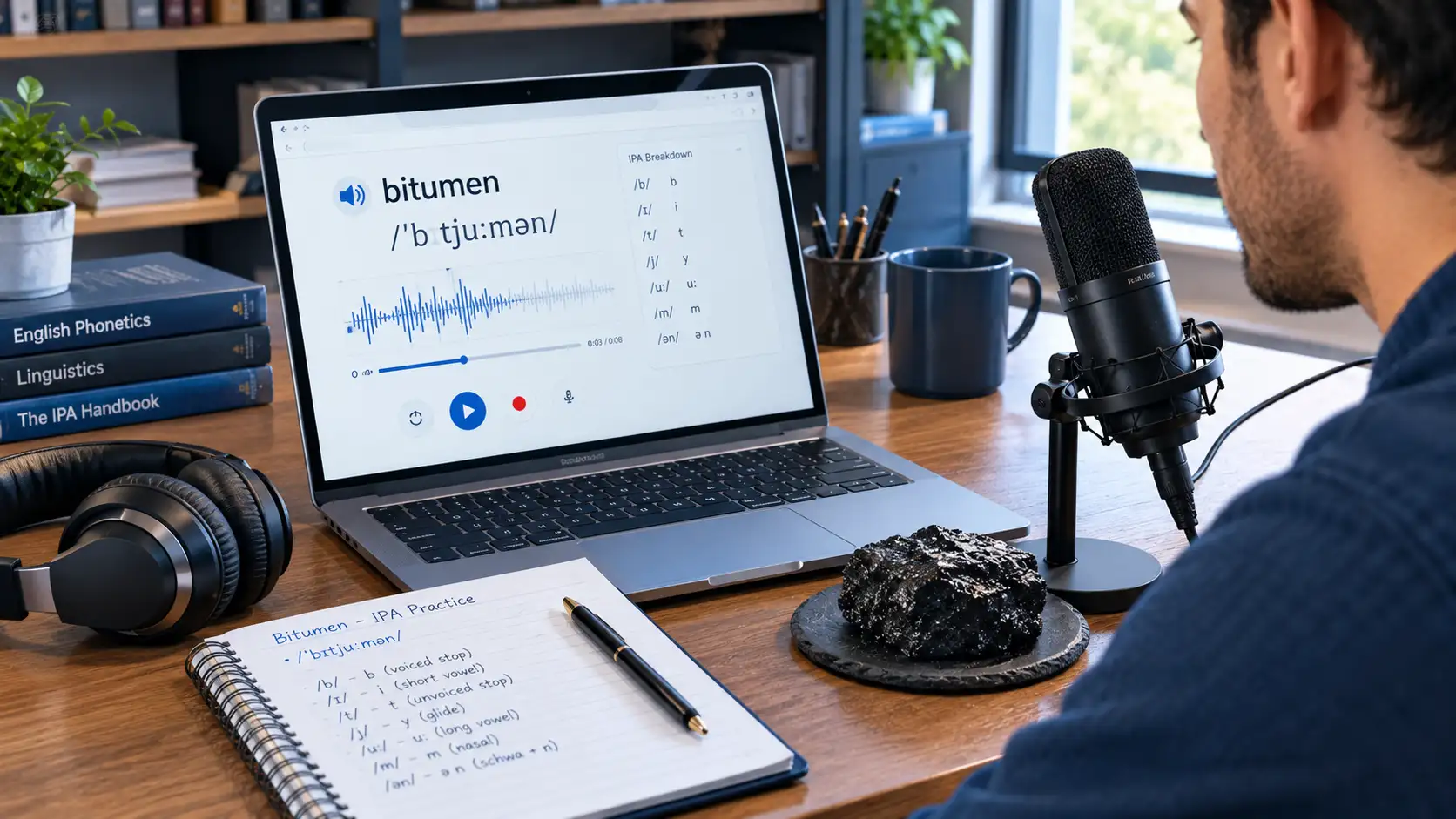
| Symbol | Sounds like | Where it appears |
|---|---|---|
| /b/ | 'b' in book | First sound in every accent |
| /ɪ/ | 'i' in ship | First vowel in British and Oxford US form |
| /aɪ/ | 'eye' | First vowel in bye-TOO-mun |
| /ə/ | 'a' in above | Weak schwa vowel in British and US |
| /tʃ/ | 'ch' in cheese | Middle sound in British BICH-uh-mun |
| /t/ | 't' in town | Middle sound in American forms |
| /tj/ | 't' plus a short 'y' | Middle sound in BIT-yuh-mun and TYOO-mun |
| /uː/ | 'oo' in blue | Stressed vowel in American forms |
| /ʊ/ | 'oo' in book | Short vowel in /ˈbɪtjʊmən/ |
| /m/ | 'm' in moon | Third-last sound |
| /n/ | 'n' in name | Last sound |
The mark /\u02c8/ goes before the stressed syllable. Small differences between dictionary transcriptions are normal. For the last syllable, say “mun” with your jaw relaxed.
Syllables, Stress, and the Schwa
Bitumen has 3 syllables: bi-tu-men.
| Syllable 1 | Syllable 2 | Syllable 3 | |
|---|---|---|---|
| British | BI (strong) | tu (weak) | men (weak) |
| American | bi (weak or 'bye') | TU (strong) | men (weak) |
What word stress does
English speakers listen for stress patterns as much as individual sounds. A stressed syllable is longer, a little louder, and higher in pitch. The wrong stress can make a word sound unfamiliar even when every sound is correct.
The schwa /\u0259/
The schwa is the most common vowel in English — a short, relaxed “uh.” Learners who give every vowel its full sound tend to say “bit-YOO-men” with three equal beats — understandable, but stiff. Shorten the unstressed parts and the word flows.
Accent comparison: “Laboratory” is a familiar case: British say luh-BOR-uh-tree, Americans say LAB-ruh-tor-ee. Bitumen follows the same kind of stress split between accents.
Why the Pronunciation Varies
The word comes from Latin bitumen, meaning mineral pitch. Merriam-Webster dates its first known use to the 15th century — long enough for accents to diverge. Three changes explain most of the variation you hear today.
British English settled on first-syllable stress. American English settled on second-syllable stress.
British English merged them into 'ch.' American English commonly dropped the 'y' and kept a clean 't.'
When a syllable loses stress, its vowel weakens. That's why the first vowel in the American form appears as 'buh,' 'bih,' or 'bye' depending on the dictionary.
The long “eye” opening in bye-TOO-mun likely comes from English spelling rules: an “i” followed by one consonant and another vowel is often read long, as in “item” or “biting.” Forvo has recordings of bitumen in German, Dutch, and Danish — each language pronounces it by its own rules.
Common Pronunciation Mistakes
Saying BICH-uh-MEN or buh-TOO-MEN puts weight on the last syllable. The correct ending is a soft 'mun' — short and relaxed.
'BIT-um' is a common error. Bitumen needs all 3 syllables. If you drop the middle one, it can sound like 'bittern' or something else entirely.
Starting with British 'BICH' and finishing with American 'TOO' doesn't match either standard. It can sound inconsistent in formal contexts.
'Bit-you-men' with three even beats is a spelling pronunciation. Choose which syllable is strong and make the others short.
Some speakers add a hard 't' or stretch the 'n,' making it 'bitument' or 'bituMEEN.' Stop cleanly on the 'n.'
In the British form, the first vowel is short, as in 'bit.' Saying BEE-choo-men changes the word. Keep it quick.
The spelling is b-i-t-u-m-e-n. Learners sometimes write 'bitumin.' Remember the 'e' before the final 'n.'
What Bitumen Means
Bitumen is a black, sticky, thick material made of hydrocarbons. Builders use it as a binder in road surfaces and as a waterproofing material on roofs, pipes, and foundations. Most bitumen used in construction is the heavy residue left after crude oil is refined.
| Term | Meaning | Where it's common |
|---|---|---|
| Bitumen | The sticky binder, from crude oil or natural deposits | UK, Australia, Canada, South Asia, most of the world |
| Asphalt | Finished mix of bitumen, stone, and sand (most countries); the binder itself in the US | Worldwide — meaning varies by region |
| Tar | A different material made from coal or wood | Roofing and older road work |
Tar and bitumen look alike but behave differently. In the US, the binder is often called “asphalt cement,” which is why Americans say “asphalt” where others say “bitumen.” Our asphalt vs bitumen comparison guide breaks down exactly when each term applies and where the regional terminology diverges.
Which Pronunciation Should You Use?

Use the form that matches the people around you.
Engineers, contractors, and suppliers hear all of these versions every week. Consistency is what stands out. If you switch accents in the middle of a word, people notice.
A 10-Minute Practice Routine
Listen and repeat
- Pick British or American English.
- Open a dictionary recording (Cambridge, Oxford, or Merriam-Webster) and listen 3 times without speaking.
- Tap the table every time you hear the stressed syllable.
- Say the word slowly 5 times, then at normal speed 5 times.
Build the word in parts
- British: BICH → BICH-uh → BICH-uh-mun
- American: TOO → buh-TOO → buh-TOO-mun
- The last two syllables of buh-TYOO-mun rhyme with 'human.' Say 'human' first and add 'buh' at the front.
Use it in sentences
- The crew heated the bitumen before mixing it with stone.
- The roof membrane contains polymer-modified bitumen.
- The specification lists the required bitumen grade.
- Canadian oil sands hold large deposits of natural bitumen.
- The contractor ordered enough bitumen for the whole driveway.
- Bituminous coal burns differently from bitumen.
Use it in real situations
- Try: 'We're waiting on the bitumen delivery. It should arrive Thursday.'
- Say it in a phone call, a class discussion, or a team meeting.
- Record yourself and compare to the dictionary audio. Check: same syllable stressed? Last syllable short? One accent throughout?
Practice tools
UK and US audio recordings on every word page
Native speaker recordings including an Australian bitumen recording
Scores your pronunciation and highlights weak sounds
Free and the easiest way to hear yourself speak
Conclusion
British English says BICH-uh-mun, sometimes BIT-yuh-mun, with the beat on the first syllable. American English says buh-TOO-mun, bye-TOO-mun, or bih-TOO-mun, with the beat on the second. Australians commonly use a British-type form.
Whichever form you choose, keep the unstressed vowels short, end with a soft “mun,” and use one accent from start to finish.
Once you can say it confidently, the next step is understanding what it does in construction. Our bitumen emulsion guide explains how the binder is turned into a cold-applied water-based form. You can also use the free bitumen quantity calculator to see just how much of the material a typical road project actually needs.
Frequently Asked Questions
How many syllables does bitumen have?
It has 3 syllables: bi-tu-men. The stress falls on the first syllable in British English and the second in American English.
Is the 't' in bitumen silent?
No. In American English it's a clear 't.' In British English it blends with the next sound and becomes 'ch,' as in BICH-uh-mun.
What is the British pronunciation of bitumen?
The common British form is BICH-uh-mun (/ˈbɪtʃ.ə.mən/). Another British form is BIT-yuh-mun (/ˈbɪtjʊmən/).
What is the American pronunciation of bitumen?
Usually buh-TOO-mun, bye-TOO-mun, or bih-TOO-mun. The second syllable takes the stress in every American form.
How do Australians say bitumen?
Most use a British-type form with first-syllable stress. Both BICH-uh-mun and BIT-yuh-mun are common.
Is 'bit-you-men' wrong?
It's close to the BIT-yuh-mun form when the last two syllables are kept weak. Saying all three with equal force sounds unnatural — choose one syllable to stress.
How do you pronounce bituminous?
It's buh-TOO-muh-nus in American English and buh-TYOO-mih-nus in British English. 4 syllables, stress on the second.
Does bitumen rhyme with anything?
The American buh-TYOO-mun rhymes with 'human' in its last two syllables. Merriam-Webster also includes 'acumen' and 'cumin.'
Is bitumen the same as asphalt?
In the US, often yes. In most other countries, bitumen is the binder and asphalt is the finished mix of bitumen, stone, and sand.
Is bitumen the same as tar?
No. Tar is made from coal or wood. Bitumen comes from petroleum or natural deposits.
What does bitumen mean in Australia?
It names the material, and in everyday speech it also refers to a sealed road surface — 'a kilometre of bitumen' means a stretch of paved road.

Founder & Web Developer
Nabeel Awan is a web developer and the founder of BitumenCalcPro. His work focuses on web development and building practical online tools, with a strong interest in civil engineering, asphalt, bitumen, pavement construction, and construction technology.