
Quick Answer
Bitumen quality tests measure how a binder behaves under heat, stress, and stretching before it ever reaches a road or roof. The core tests are penetration, viscosity, softening point, ductility, specific gravity, flash point and fire point, and solubility, plus an extraction test used to check bitumen content inside an already-mixed asphalt sample. Each test checks a different property, and together they confirm a batch meets its grade before it is approved for use.
No refinery or contractor hands over bitumen without running it through a set of standardized checks first. A single physical property like how sticky or stiff a sample looks does not tell an engineer whether that binder will hold up on a summer highway or crack apart on a cold roof deck. That is what quality tests for bitumen are built to answer, and each one isolates a different behavior so a supplier and a buyer can agree on exactly what they are getting.
This guide walks through every standard test, what it measures, and why the result actually matters on a job site. If you are newer to the material itself, our complete guide to bitumen covers the chemistry, types, and applications before you dive into the testing side.
Why Bitumen Quality Testing Matters
Bitumen is a viscoelastic material. It has no sharp melting point the way ice does. Instead, it gradually softens as temperature rises and stiffens as it falls, which means a single description like “60/70 grade” only means something once it is tied to a repeatable, standardized test result. Understanding the full bitumen grading system makes the purpose of each test far clearer, since grades are defined entirely by their test results.
Get the wrong grade onto a project, and the failure shows up months or years later: rutting in a hot summer, cracking in a cold winter, or a roofing membrane that never should have passed inspection. Quality testing exists to catch a mismatched or substandard batch before it is compacted into a road or torched onto a roof, not after.
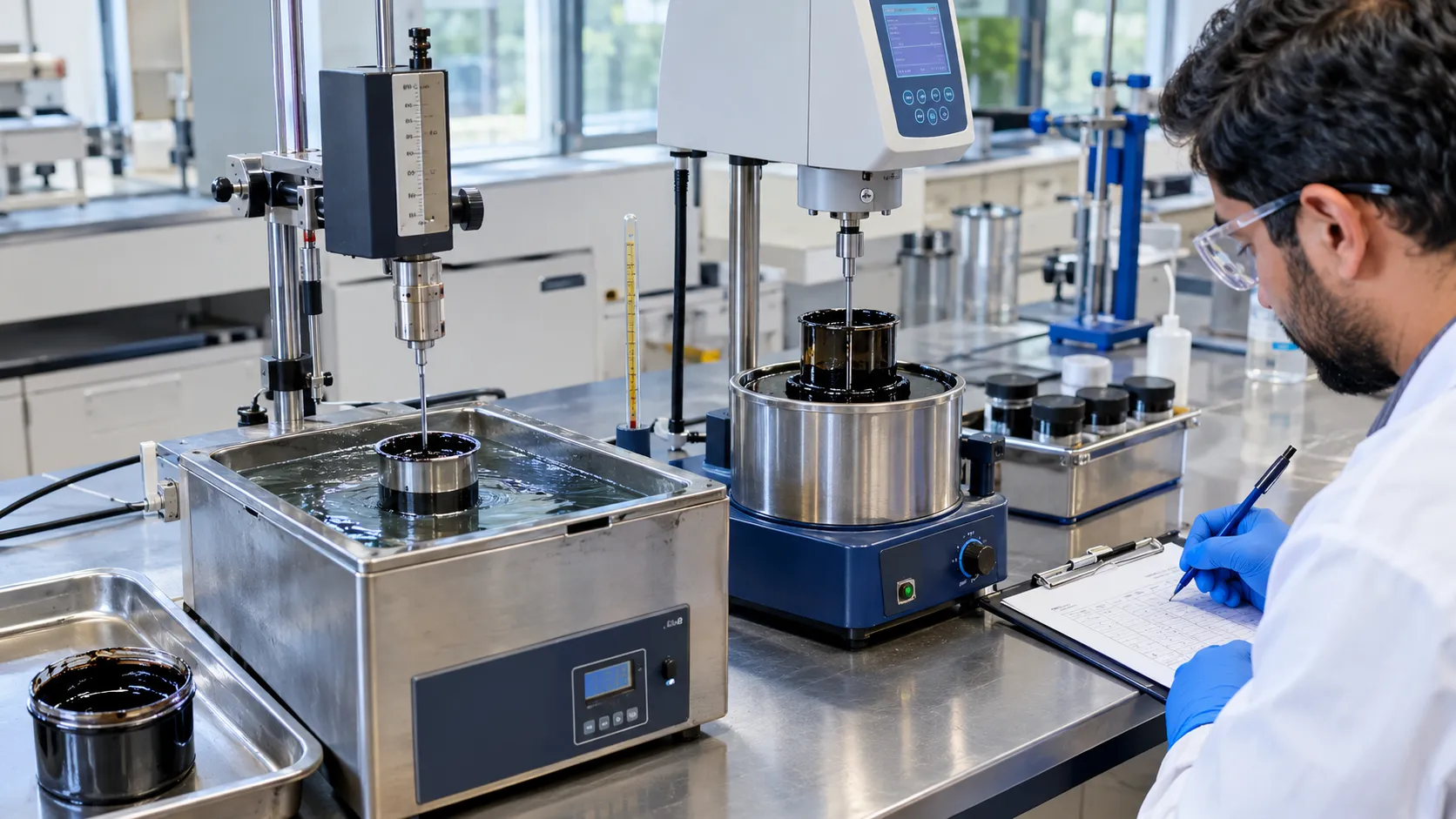
Penetration Test
Penetration is the oldest and most widely recognized bitumen classification test, and it is still the basis for naming grades like 60/70 and 80/100.
How It Works (ASTM D5)
A needle loaded to 100 grams is lowered onto a bitumen sample held at 25°C, then released for exactly 5 seconds. The distance it sinks, measured in tenths of a millimeter, is the penetration value. A “60/70” bitumen means the needle sinks between 60 and 70 units under these exact conditions.
Lower numbers mean a harder binder, higher numbers mean a softer one. This single number is still the most common shorthand engineers use worldwide to describe a bitumen's basic hardness, and it is the starting point for selecting a grade suited to the climate and traffic load of a given project.
Bitumen Viscosity Test
Viscosity measures how easily bitumen flows, and it is one of the most important quality tests for bitumen because it directly predicts mixing behavior and rutting resistance.
Two temperatures matter most. At 60°C, absolute viscosity is measured using a vacuum capillary viscometer, since this temperature approximates the hottest a road surface reaches in summer service. At 135°C, kinematic viscosity is measured using an atmospheric capillary tube, since this is close to typical mixing plant temperatures, and the result confirms the bitumen will coat aggregate properly without being dangerously runny or too thick to pump.
Two Common Instruments
Saybolt Furol Viscometer
Measures the time for 60 mL of sample to flow through a calibrated orifice, reported in Saybolt Furol seconds. Simple, inexpensive, and commonly used for liquid products like bitumen emulsion.
Rotational (Brookfield) Viscometer
Measures torque needed to rotate a spindle at constant speed inside the heated sample, typically at 135°C. Standardized as ASTM D4402 / AASHTO T316 and required for Superpave performance-grade (PG) binders.
A binder that is too viscous is hard to pump and coats aggregate unevenly. One that is too thin will not hold its film on the stone and drains off before compaction. Either mistake shows up as a weak, short-lived pavement — the same failure modes covered in our look at the most common asphalt estimation mistakes.

Bitumen Ductility Testing
Ductility measures flexibility, which is one of the properties standard hardness testing alone cannot reveal.
How It Works (ASTM D113)
A dogbone-shaped bitumen sample called a briquet is pulled apart at a controlled speed of 5 cm per minute, at a standard temperature of 25°C, until it breaks. The distance the sample stretches before separating, in centimeters, is the ductility value.
A binder with poor ductility is brittle and cracks under the small, repeated movements a road surface experiences from traffic and temperature swings. High ductility means the bitumen can deform and recover without immediately fracturing, which matters far more than raw hardness for long-term crack resistance.
Some specifications also run ductility testing at lower temperatures like 4°C, specifically to check cold-weather flexibility. This is particularly important when evaluating binders destined for cold climates, where brittleness from temperature alone can cause cracking under load.
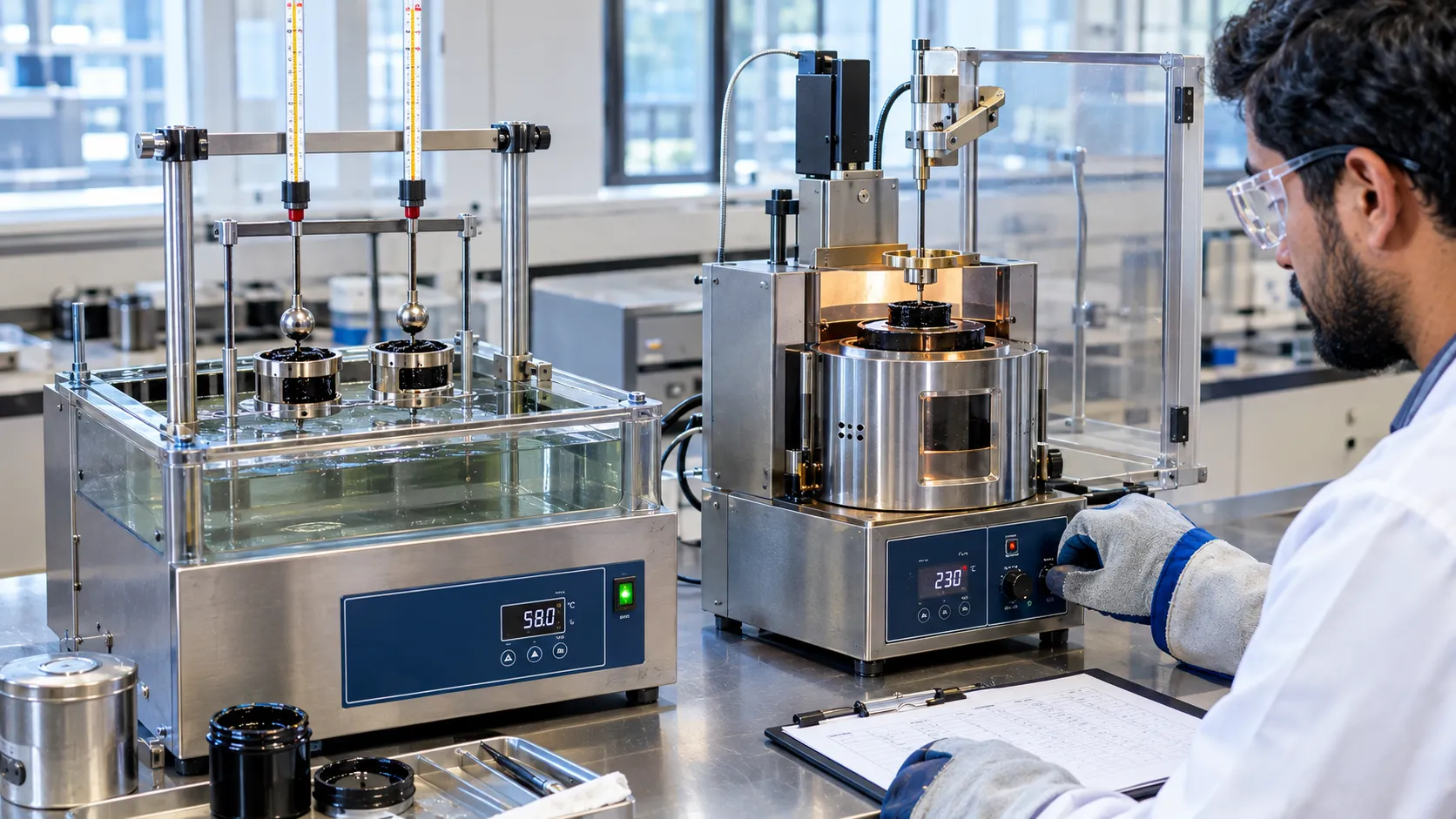
Softening Point Test
Bitumen does not melt at a fixed temperature the way ice does, so softening point testing gives engineers a standardized, repeatable stand-in for that missing melting point.
How It Works — Ring-and-Ball (ASTM D36)
Two horizontal discs of bitumen, each set inside a small metal ring, are heated in a water or glycerin bath while a steel ball rests on top of each. As the temperature climbs at a controlled rate, the bitumen softens until the ball sinks through it and touches a marked plate below. The temperature at that exact moment is the softening point, and the standard test method covers a range from 30°C to 157°C.
Softening point tells you the practical upper temperature limit before a binder starts to flow and lose its shape. This is especially critical for oxidized (blown) bitumen used in modified bitumen roofing systems, where a low softening point means the membrane could soften and slump on a hot day.
Flash and Fire Point Test
This test exists purely for safety, since bitumen has to be heated well above ordinary temperatures before it becomes workable, and the flash point is the line between routine heating and a real fire hazard.
How It Works — Cleveland Open Cup (ASTM D92)
A sample is heated in an open cup at a controlled rate while a small test flame passes over the surface at regular intervals. The flash point is the lowest temperature at which vapors above the sample briefly ignite when the flame passes. Continued heating identifies the fire point, the temperature at which the sample ignites and keeps burning for at least 5 seconds.
In practice, flash points for paving bitumen commonly fall in the 300 to 360°C range, with fire points typically 20 to 30°C higher.
Every heating and mixing operation needs to stay comfortably below the flash point to avoid a real fire hazard. This number is written directly into a bitumen's safety data sheet and used to set safe maximum heating temperatures at plants and job sites. The Asphalt Institute safety guidance references flash point limits as a key parameter in plant operating procedures.

Specific Gravity Test
Specific gravity compares bitumen's density to water's at the same temperature, and it is a fast way to check consistency and spot problems.
How It Works (ASTM D70)
A pycnometer, a small glass vessel of precisely known volume, is used to weigh a bitumen sample against an equal volume of water at a controlled temperature, typically 25°C. Dividing the two weights gives the specific gravity, a unitless ratio.
Most paving-grade bitumen has a specific gravity just above 1.00, meaning it is marginally denser than water. A reading that falls noticeably outside the expected range for a given grade can signal dilution with a lighter petroleum product or contamination, making specific gravity a useful, low-cost first check before deeper testing. The same density principle is explored in the bitumen density chart by grade.
Solubility Test
Solubility testing answers a basic but important question: how much of this sample is actually bitumen, and how much is something else.
How It Works (ASTM D2042)
A weighed bitumen sample is dissolved in trichloroethylene, then filtered. Anything that does not dissolve, including mineral matter, carbon residue, or other contaminants, is measured and subtracted, giving a percentage of pure bitumen in the sample.
Specifications typically require a solubility of at least 99% for paving-grade bitumen. A lower result usually points to the presence of inert filler, excessive carbon from overheating during production, or contamination introduced somewhere in the supply chain. Our guide on how bitumen is transported covers the handling risks that can affect purity during transit from refinery to site.
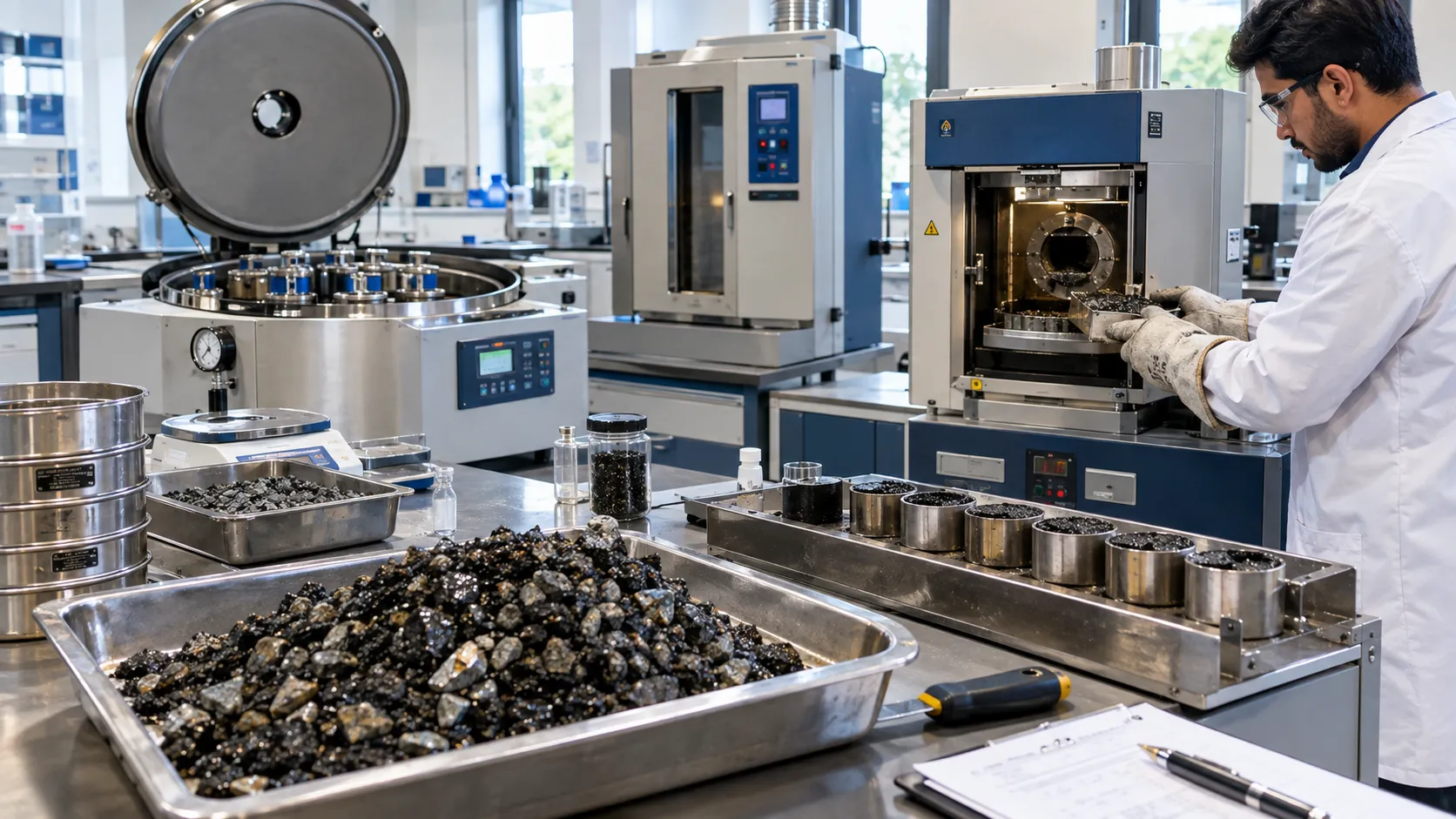
Bitumen Extraction Test
The extraction test is different from every test above it, since it is not run on raw bitumen at all. It is run on a finished asphalt mix to determine how much bitumen the mix actually contains.
Two Standard Methods
Centrifuge Extraction (AASHTO T164)
Dissolves the asphalt sample in a solvent inside a centrifuge, spinning off the aggregate and leaving the dissolved bitumen in the solvent, which is then measured. Accurate but requires solvent handling and disposal.
Ignition Furnace (AASHTO T308 / ASTM D6307)
Burns off the bitumen entirely at high temperature and calculates binder content from the weight lost, avoiding solvent use altogether. Increasingly preferred for routine quality control where solvent disposal is a concern.
This test confirms whether a paving contractor actually delivered the binder content specified in the mix design, rather than under-dosing bitumen to cut material cost. It is one of the most direct quality control checks available on a finished road, since it verifies the real mix rather than just the raw material that went into it. For anyone tracking project quantities from the planning stage, our free Bitumen Calculator gives the mix design baseline that the extraction test later verifies was delivered.
Comparing the Tests
Each test occupies a different role in the overall quality picture. This table maps the standard, what it measures, and the temperature it runs at, making it easier to see the full testing picture at once.
| Test | Standard | What It Measures | Typical Test Temperature |
|---|---|---|---|
| Penetration | ASTM D5 | Hardness | 25°C |
| Viscosity | ASTM D4402 / AASHTO T316 | Flow resistance | 60°C and 135°C |
| Ductility | ASTM D113 | Stretch before breaking | 25°C |
| Softening point | ASTM D36 | Temperature at which bitumen softens | 30–157°C range |
| Flash and fire point | ASTM D92 | Safe heating limit | Up to ~360°C |
| Specific gravity | ASTM D70 | Density versus water | 25°C |
| Solubility | ASTM D2042 | Purity of the bitumen sample | Ambient |
| Extraction | AASHTO T164 / T308 | Bitumen content in a finished mix | N/A (mix sample) |
How These Tests Work Together
No single test tells the whole story. A batch can pass a penetration test and still fail in service if its ductility is poor, and a binder can have excellent viscosity at 135°C but soften too easily on a hot roof if its softening point is low for the application. Specifications combine several of these tests into one grade requirement precisely because each one exposes a different weakness a single measurement would miss.
This is also why lab-tested bitumen from a reputable supplier, backed by a certificate of analysis showing results from these standard tests, is worth more than a cheaper batch with no test data attached. The tests are the only real evidence that a specific shipment will behave the way its grade name suggests.
The connection between testing and grade selection is direct. The ASTM D946 specification for penetration-grade bitumen explicitly lists minimum and maximum values across multiple tests, including penetration, ductility, solubility, and flash point, to define what any given grade must pass before it is accepted for paving use. Choosing the right grade also depends on climate, traffic, and layer depth, all of which feed into asphalt pavement thickness design.
Conclusion
Bitumen quality testing exists because a single description like a grade name is not enough to guarantee performance. Penetration and viscosity establish basic hardness and flow behavior. Ductility and softening point reveal how the binder handles stress and heat over its service life. Flash point protects workers during heating, specific gravity and solubility catch contamination, and the extraction test confirms a finished mix actually contains what its design called for.
Together, these tests are what separate a binder backed by real data from one sold on a grade name alone. They are also the reason bitumen emulsion carries different testing requirements from a hot-poured paving grade, since the application drives which properties matter most, and the tests are how those properties are verified.
If you are working with bitumen on a paving project and need to plan quantities from the design stage, our free Bitumen Calculator gives accurate estimates for mix weight, binder content, and aggregate requirements, the same figures the extraction test later verifies were delivered.
Frequently Asked Questions
What is the most important bitumen quality test?
No single test stands above the rest, since each measures a different property. Penetration and viscosity together describe basic grade and flow behavior, while ductility and softening point describe how the binder performs across a temperature range in service.
What does a bitumen ductility test measure?
It measures how far a standardized bitumen sample stretches before it breaks, pulled at 5 cm per minute at 25 degrees C. Higher ductility means better flexibility and crack resistance under traffic loading and temperature swings.
Why is the flash point test done on bitumen?
It confirms the temperature at which vapors from heated bitumen can ignite, which sets a safe upper limit for heating and mixing operations. This number appears on the material safety data sheet and is used to set plant and job-site heating limits.
What is the difference between the viscosity test and the softening point test?
Viscosity measures flow resistance at a specific temperature, usually 60 or 135 degrees C, useful for predicting mixing behavior and rutting resistance. Softening point finds the temperature at which the bitumen itself starts to soften and sag under load, which is a different, more application-focused threshold, especially important for roofing grades.
What does the extraction test tell you that other bitumen tests do not?
Every other test on this list checks raw bitumen before it is used. The extraction test checks a finished asphalt mix, confirming how much bitumen the contractor actually included — a quality control check on the paving job itself, not the raw material.
How is bitumen specific gravity useful for spotting bad batches?
A specific gravity reading noticeably outside the normal range for a given grade can indicate the bitumen has been diluted with a lighter product or contaminated. It is a quick, low-cost first screening check before more detailed testing is ordered.

Founder & Web Developer
Nabeel Awan is a web developer and the founder of BitumenCalcPro. His work focuses on web development and building practical online tools, with a strong interest in civil engineering, asphalt, bitumen, pavement construction, and construction technology.